I will be spending the holidays with family. I don't know if I'll have any time to blog, so if I don't get to say it later, Merry Christmas and Happy New Year!
P.S. Poohtie Cat says Happy Holidays, too.
P.S. Poohtie Cat says Happy Holidays, too.

Connect your appliances into the Kill-a-Watt, and assess how efficient they are. A large LCD display counts consumption by the Kilowatt-hour just like utility companies. You can figure out your electrical expenses by the hour, day, week, month, even an entire year. Monitor the quality of your power by displaying Voltage, Line Frequency, and Power Factor.
The Smart Strip Power Strip features advanced circuitry that not only offers excellent power surge protection and line noise filtering, but is actually able to 'sense' the flow of electrical current through the strip's control outlet. Because of this unique ability, the Smart Strip can turn off selected equipment when its not in use -- creating benefit that no other power strip on the market today can offer.

 Jib Jab has done it again. I just saw their new video--"2-0-5" in review--on CNN. And I'm still chuckling. Have at it.
[t]he first step in addressing any problem is to understand it. We need a really good definition of the challenges that lie ahead--technical, social and economic. Thus we start with a thorough review of the energy market. We need a realistic forecast of America's energy requirements by fuel type by year for the next 20 years. Fuel types fall into two basic categories: fuels for mobile applications (cars, trucks, railroad engines, airplanes, etc.), and fuels for stationary applications (power plants, furnaces, generators, pumps, industrial motors, etc.). Then we need a forecast of fuel resources by type by year for the same 20 year period. The supply forecast must include a conservative estimate of resource depletion, potential political challenges, and international competition for available fuels. Our market plan should also examine future cost/price trends and their potential impact on our economy.Cooke goes on to describe the "three key components of a successful business plan." It would be administered by a large organization that must manage the project. None of the components are in the 2005 act.
Where shortages appear in our forecast--and they will--we need to review alternative solutions. Again, there are two categories: energy efficiency and new resource development. Since energy efficiency improvements provide us with the quickest and cheapest solution, all avenues of improved energy efficiency must be defined and quantified. The remaining energy shortfall defines the annual fuel volume requirements of our resource development objectives.
With this Fourth Draft, we have refined our focus, sharpened our message and begun to build the financial models to support the plan, including both a funding model and target investments for each specific proposal.It sets a legislative agenda for transportation, power generation, the environment and regulatory framework, efficiency and education, and funding the campaign. The authors are asking for feedback on several levels: rhetorical, political, cost/benefits, and even the wording.

My background is in the teaching of permaculture for many years, giving people the tools to create more sustainable ways of living in their own gardens and families. Since I found out about peak oil, I have become fascinated by how we apply these principles to whole towns, whole settlements, and in particular, to how we design this transition in such a way that people will embrace it as a common journey, as a collective adventure, as something positive. So much peak oil and other environmental literature is doom-laden and information heavy, and most peoples’ reaction is to switch off. How can we design descent pathways which make people feel alive, positive and included in this process of societal transformation?It is heartening to read, in fact he makes a conscious decision to include Heart in his work:
In September 2005 I moved to Totnes in Devon, to begin a PhD at Plymouth University looking at Energy Descent Action Plans, refining the model in such a way that they can be done anywhere. This involves looking at what I call the Head, the Heart and the Hands of Energy Descent. By the Head I mean the concepts of peak oil, arguments for and against localisation as well as any historical examples that we can learn from. The Heart refers to exploring how to actually engage communities in a positive and dynamic way, how to use peak oil as a tool for empowerment rather than leaving people feeling helpless. This part of the exploration is about how to actually facilitate change, and the dynamics of cultural transformation. The Hands refers to the practical aspects, could the UK become self sufficient in food and how? How much well managed woodland would it take to heat a town with efficient CHPs? Can local materials be used to retrofit houses?
This reminds me of the 4H pledge that Mr. Logan taught me:
I pledge My head to clearer thinking,
My heart to greater loyalty,
My hands to larger service, and
My health to better living,
For my club, my community, my country, and my world.
I thouroughly enjoyed every entry and invite you to visit often.
Dear Members:He goes on to say that they will send out an energy professional to our homes to discuss how we can lower our energy usage.
Those of you who have lived in Georgia for at least one summer know that, on a hot summer afternoon when the clouds get dark and you hear thunder off in the distance, we are about to have a storm. People adjust their plans and get ready for what might come.
Currently, we are hearing the thunder of increasing energy costs and seeing the darkening clouds of a tightening energy supply of the various raw commodities used to produce electric energy. It appears that this is the prelude of what "might" come very soon, increased electrical rates.* With the tightening of the supply of coal and natural gas, two (2) of the most popular fuels used in the production of electric energy, coupled with record increases in the commodity price of these fuels, many people believe we are on the verge of a 1970s style energy crisis. We are not ready to sound that alarm just yet but want you, our members, to be aware that the "sky is getting dark" and like with that afternoon storm, we need to prepare...
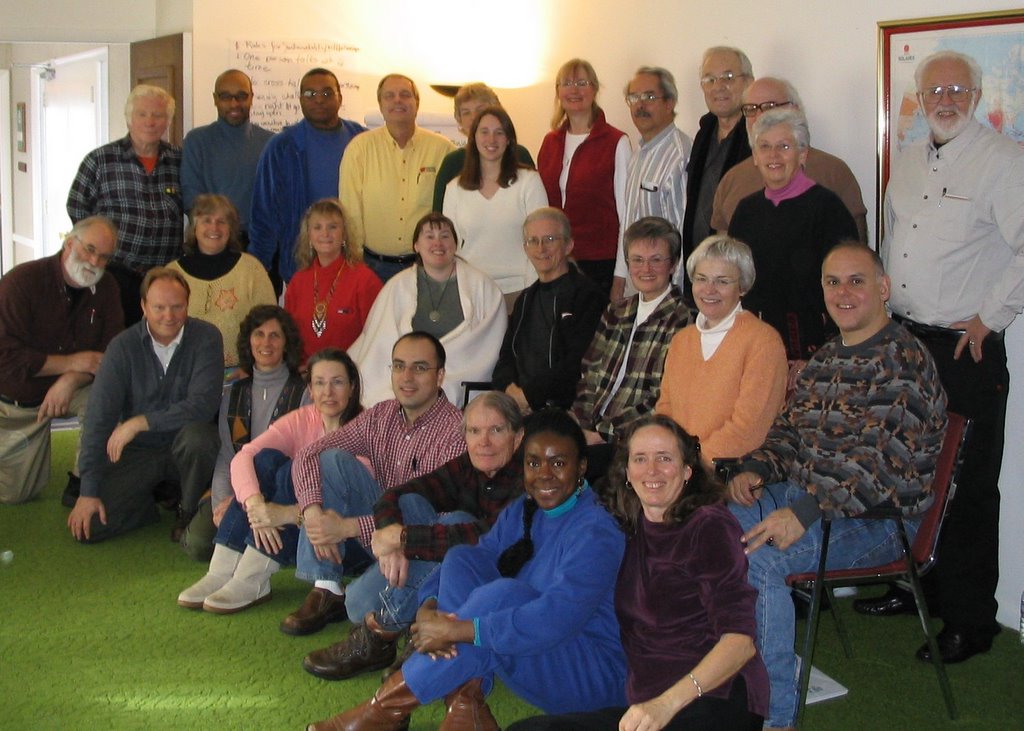 I am back from a very empowering weekend produced by Community Solutions and hosted by the Center for Sustainable Community at Stelle in Illinois.
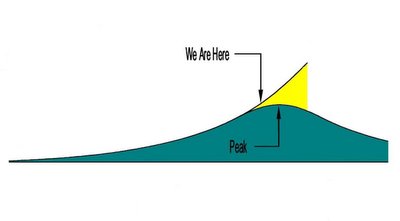
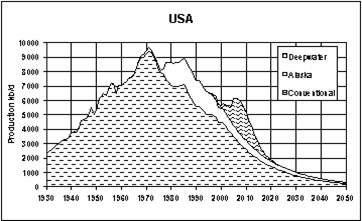 The first shows the peak of US production.
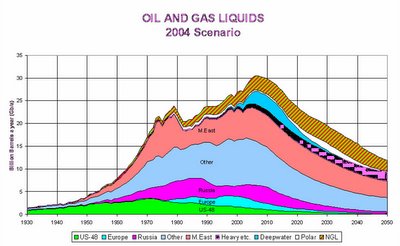 The third is world oil production.
Several hours or so later with buckets, shovels, a rake, gallons of bleach, and garbage bags piled high in the back of the rented minivan, we arrived at Lester’s home, donned gloves and masks and plunged into work. His home is quite big and we literally attacked each room. We were determined to get the muddied, molded and waterlogged furniture, appliances and stuff out of the house and onto the curb. Having a deadline of only a few days to work kept us moving even as the stench permeated into our brains with a dull headache, the waterlogged carpets and slime soaked floors threatened to spill us with one misstep and the itchy masks formed prickly goatees of sweat on our faces.The end by relfecting that Los Angeles, indeed the world, has its own "big one" that looms--are we really ready to be without power, water and infrasturcture?
For those who want not to just read about peak oil or the end of the world scenarios – go to New Orleans and find out first hand. Reading in the comfy of your surroundings is one thing; living the nightmare is another.
The implication is that we may not have much time to adapt to a post-peak world.



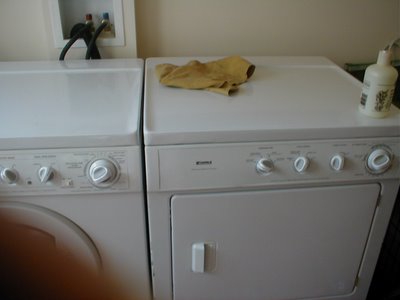

They did a beautiful job tiling the shower, so I had to take a shot of it.

This is their composting toilet. The gasmask is a joke. It has a fan in the tank below which pulls the air out of the bathroom.

This is the waste pipe for the toilet upstairs.
 The salvaged the beautiful oak floors from a schoolhouse slated for demolition.
 This stove heats the place with downed wood they collect. The house is so well insulated it doesn't take much to get warm. "Pancho" (a plastic Einstein doll) rides atop the cowboy hat.
 They learned how to set tile on their screened in back porch. We got to meet Hemingway, who is a very friendly 5 month old.
We went out the back door for a look at the graywater system.
 It comes out these pipes...
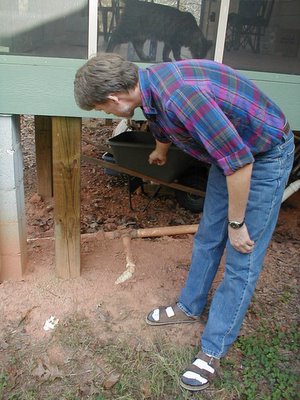 and gets sent to one of the two fields via this valve, which he switches every couple of weeks to let the mulch dry out...
 and it comes out of this pipe into the drainage cachement which sends the water to nourish a fruit tree.
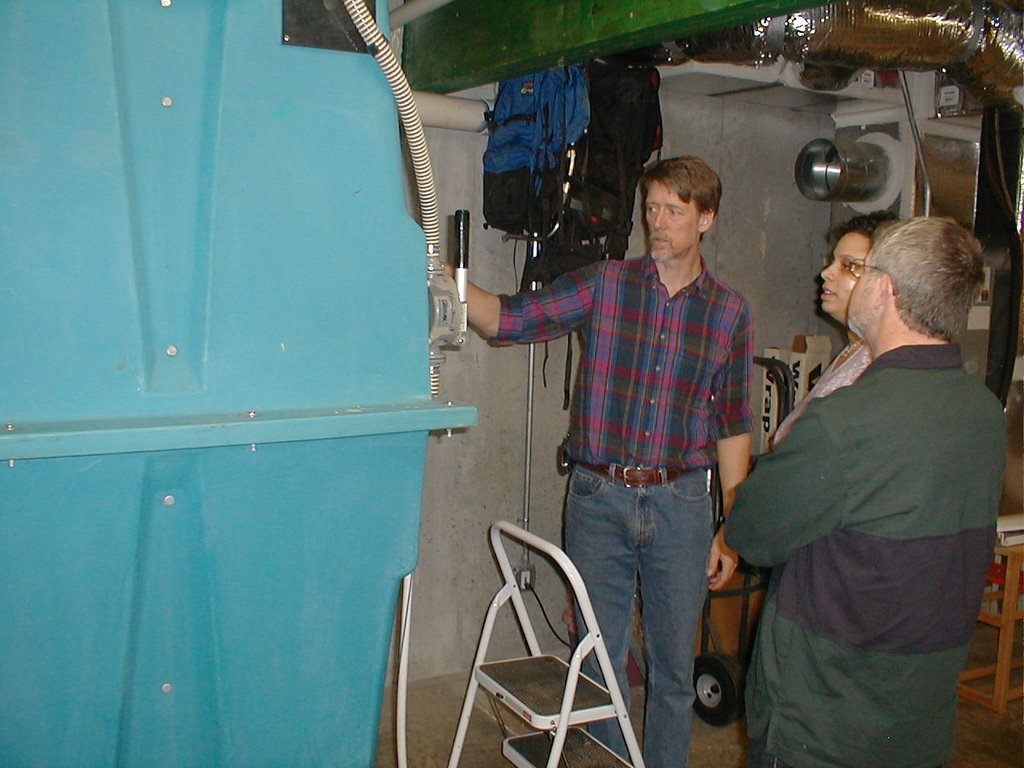
Now its time for a trip to the basement to see the inner workings of the house.
 It was built with this insulating material, made of Styrofoam sandwiched between OSB. The ones in the outside walls are about 4" thick and have an R factor of 17. The ones on the roof are thicker.
An airtight house means a ventilation system is needed. When people ask if they will get sick from a well sealed home, Allison responds that a home can't be too tight, just underventilated.
 This one exchanges heat between the air going in and going out. The next step up exchanges humidity as well.
 This pipe evacuates the radon from underground. Its easy to install if you do it when pouring the slab. The negative air pressure draws radon gas up and out the vent in the roof.
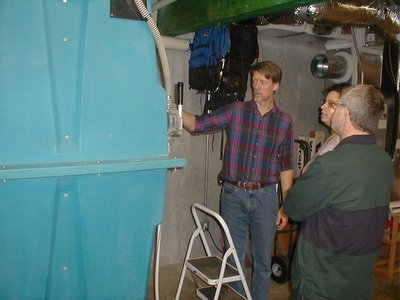 This is the tank of the composting toilet.
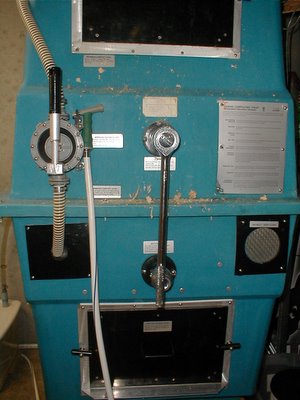 The sawdust gets stirred by tines attached to the top axel. The compost comes out of the bottom panel.
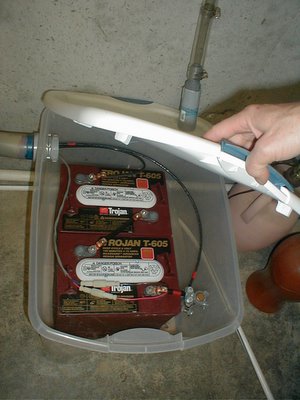 The fan and the light (to attract and kill mold gnats) is on a 12 volt system.
 The water pump is also powered by these batteries.
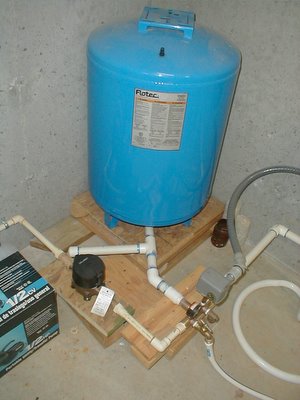 The water is pressurized in this tank.
Now its time to tour the grounds.
 The greenhouse.
 A tractor from the 1940s that they got running with a little TLC and a lot of moola.
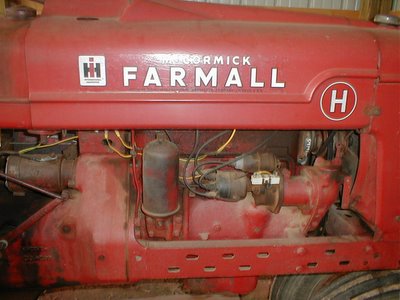 My hubby used to ride on one of these growing up on the farm.
 Next year this area will have chickens and maybe goats. The mound is their compost pile.
 The garden/field is fenced off to protect it from the deer. Apple scented modules lure them and then shocks their noses. They learn to stay away instead of figuring out that they can jump the fence.
 The well is 302 feet deep.
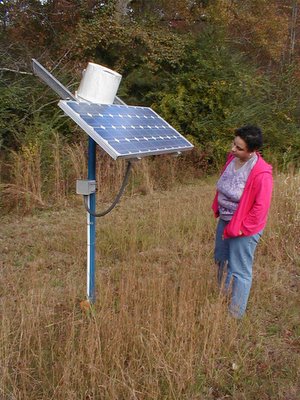 The pump is powered by this solar panel.
 We learned a lot and had a great time hanging out. Thanks for your hospitality, Allison, and thanks for coming everyone!
If Peak Oil theory is now mainstream, splashed across the front page of USA Today and the theme of Chevron and BP ad campaigns, then Petrocollapse is a secular, left-wing, non-fiction version of Tim LaHaye's Christian Apocalyptic "Left Behind" series. The gospel according to Petrocollapse is that Peak Oil is coming, and it's coming soon. The transition to the post-carbon world will not be gradual, it will be sudden and massive. And when it comes, the sinners--those profligate American consumers and the corporate whores who oversee them--will all be swept away in violent social turmoil, starvation and environmental disaster. But there's good news too. After the tumultuous mass die-off, a new society will arise from the burned out SUV hulks and melted plastic detritus. In this post-carbon world, humans will have no choice but to live sustainably, in cooperation with each other and in harmony with nature. Those who get religion and accept Peak Oil into their hearts soon enough--they may be among the lucky survivors whose children grow to live in this new and better world.On the other hand, the next event was all about policy.
If the Petrocollapse conference was dominated by conspiracy theorists, then Winning the Oil Endgame" was the Conspiracy. Present on the dais were former CIA director James Woolsey, Mississippi Governor and former Republican National Committee Chairman Haley Barbour, former Deputy Secretary of the Treasury Robert Altman and Amory Lovins, CEO of the Rocky Mountain Institute.They promoted drilling, nuclear power, coal-fired electricity, natural gas and more efficient vehicles. Little mention was made of the "profound environmental problems and danger" of fossil fuels.
Far from doom and gloom, the Endgame speakers were nearly united in their belief that it was both possible and desirable to keep finding fixes for America's energy Jones and to keep the American consumer machine rolling along using new technologies.
Komanoff acknowledges the possible validity of the Peak Oil analysis, but having heard similar End Times prophecies thirty years ago, he isn't allowing the Peak Oil argument to guide his work and activism. "I think there's an element of wishful thinking and that some Peak Oil adherents are looking for a deus ex machina to sweep away the disaster that is contemporary industrial civilization," he said. "And understandably so. Waiting for Peak Oil is so convenient, so much simpler, and so much more seductive than the hard work of organizing for social and ecological change."Finally, Naparstek looks at the NYC Oil Awareness Meetup group. This is the same network that I am involved with so I was particularly interested in how other groups are developing. They deal with the emotional component and have started a subgroup formed to help people get through the paralysis that learning about peak oil brings. Philosophically, they have broken into two approaches: "The Relocalizers believe New York City won't be viable in the age of Peak Oil and are looking for new places to live and new skills to live in a world without modern conveniences. The Sustainable New Yorkers are dedicated to educating and preparing the city for what they see as a lengthy and potentially tumultuous energy crisis."
Komanoff was also critical of the Endgame analysis. "There is a big dissonance between Amory's kind of chirpy optimism and actual realities on the ground and actual energy trends." Three decades after Lovins unveiled his revolutionary "soft energy path," Komanoff points out, the U.S. uses 25% more oil, burns 75% more coal and generates 35% more greenhouse gases than it did in the mid-1970s. Though a 66 mpg SUV is certainly more desirable than Detroit's current state of the art, Komanoff doesn't believe Lovins' hyper car project provides us with real answers for our global energy and environmental quandary because the project is "only about improving the fuel efficiency of the vehicle and does nothing about addressing the social and whole system efficiency of travel and mobility and community."
In my group, similar distinctions apply. As one member put it, there are "three possible scenarios for the P.O. future, and I can actually argue in support of each:"Despite such dread, there is often a sense of action and possibility at the monthly meeting. Miner makes a point of emphasizing that there are things you can do to prepare for Peak Oil and people interested in doing them with you. At the Meetup, you aren't so much assaulted by the gloomy hopelessness that pervaded the Petrocollapse and Endgame conferences.
1) Nothing Happens (Yergin): Things keep going smoothly (with maybe a slight bump in the road), alternative energy sources are identified in time and the economy will continue to grow at 4% indefinitely-business as usual. The Deniers say, "Everything is fine."We found this to be an interesting starting point in identifying where each of us fell on the spectrum, and hope to create a group that can meet the needs of each.
2) Soft Landing (Simmons): The energy crunch causes, at minimum, a recession or possibly a full-blown depression. The US has been through recessions before and will weather this one. A global depression may result as the US economy falters and consumers stop spending but in the end. "We'll tighten our belts and pull through somehow."
3) Hard Landing (Kunstler): The worst case scenario is an economic and social collapse-the stuff of doomsayers' dreams. "Oh shit."
Some Peakniks come in somewhere between 1 and 2, or between 2 and 3. The optimistic 1.5ers see a problem, but believe we can address it-they're the Organizers and Activists. 1.5ers will push for education, political action and programs like carpooling, bike lanes, public transportation, and tax credits for installing solar.
The 2.5ers are the Preparers; they're less optimistic and will be more concerned with readying for a stark, downscaled future-learning about farmsteading and food storage, getting off the grid, learning self defense.
The 3-or-worse crowd (the Survivalists or Apocalyptics) will start hoarding food, buying rural property and stockpiling ammunition like a survivalist. (NOTE: None of these generalizations are intended to be judgmental; everyone has to follow their own instincts.)