This video was created for the AARP "U@50" video contest and placed second. It is called "Lost Generation."
Link to YouTube
Monday, January 26, 2009

Sunday, January 18, 2009
Declaration of Independence
This is just a fly-by post to share a beautiful document. It is an evolving story, and I'll keep you posted.
The Transition Declaration of Independence.
The comments are worth a read as well.
The Transition Declaration of Independence.
The comments are worth a read as well.
Tuesday, January 06, 2009
Reflections on Intentional Communities
I had two opportunities to interact with intentional communities last month; one as an observer and one as a participant.
I am taking a second round of facilitation training for communities, this time with Laird Schaub, who originated the two-year program. (Regular readers may remember that I did seven sessions with Tree Bressen in 2006 and 2007.) We had our second weekend together, and I am totally hooked on the high of being with 18 other people who are just as passionate about facilitating in communities as I am. I am also really amazed at all of the community-oriented activities that are happening in Asheville, NC.
Over the course of this, I got to observe a cohousing meeting. They were discussing what they could do with a plot of garden to grow more of their own food. First we had them visualize the garden five years down the road. Then they spent a long time brainstorming, and we had two scribes noting everything down. They were a pretty savvy group, and ended up covering all of the bases that a permaculture consultant would have addressed. I know this because DH and I recently had permaculture consultants develop a plan for our yard.
As the brainstorming wore on, I found myself thinking "why don't they just hire an expert and be done with it?" Which is not like me, as I have a high tolerance for brainstorming-type of activities. But 45 minutes pushed even my limits. However, I thought about a basic principle of organizational communication that I learned years ago: participation = buy in. The ideas they generated were their ideas, not somebody else's, who was telling them what to do.
The next part of the meeting was very lively. Our scribes cut up all of the flip chart pages so that each idea was on its own strip. Then we spread them all out, face up, on the floor. In the next 14 minutes, the cohousers put them into clusters. They moved the strips around, looked at what they had done, discussed, argued, negotiated, and moved them again. Then the facilitator had them review each cluster one more time, and come up with a label for that cluster. This exercise is called "snow cards" or "blizzard" because all of the white pieces of paper blanket the floor or wall like snow.
Now the clusters were manageable, and the group figured out where they would start, and who would shepherd the process until they figured out exactly how it would continue. The whole thing took three hours, and they were very satisfied with the work they got done. And how much fun they had.
Meanwhile, I was at the back of the room scribbling notes about the structures the group had and processes they were using to make this kind of decision. Another principle of organizational communication is that structures influence behavior. However, most people don't think about this when they are frustrated with the way somebody is acting. They usually attribute it to a deficit in that person. So it can be very useful to look at the structures and processes, and make sure they are aligned with the organizations purpose, values, and assumptions.
What I have learned from Laird and Tree and Diana Leaf Christian is that there are some very specific recommendations they make for intentional communities, gleaned from their years of experience living in and facilitating them. And as they haven't published their books on this topic yet (ahem!) I am creating my own process maps. Ultimately I am hoping that we can create an open source library of these maps that communities use, so that they can diagnose problems and don't have to reinvent the wheel.
I'll talk about my other adventures next time.
PS. Happy New Year!
I am taking a second round of facilitation training for communities, this time with Laird Schaub, who originated the two-year program. (Regular readers may remember that I did seven sessions with Tree Bressen in 2006 and 2007.) We had our second weekend together, and I am totally hooked on the high of being with 18 other people who are just as passionate about facilitating in communities as I am. I am also really amazed at all of the community-oriented activities that are happening in Asheville, NC.
Over the course of this, I got to observe a cohousing meeting. They were discussing what they could do with a plot of garden to grow more of their own food. First we had them visualize the garden five years down the road. Then they spent a long time brainstorming, and we had two scribes noting everything down. They were a pretty savvy group, and ended up covering all of the bases that a permaculture consultant would have addressed. I know this because DH and I recently had permaculture consultants develop a plan for our yard.
As the brainstorming wore on, I found myself thinking "why don't they just hire an expert and be done with it?" Which is not like me, as I have a high tolerance for brainstorming-type of activities. But 45 minutes pushed even my limits. However, I thought about a basic principle of organizational communication that I learned years ago: participation = buy in. The ideas they generated were their ideas, not somebody else's, who was telling them what to do.
The next part of the meeting was very lively. Our scribes cut up all of the flip chart pages so that each idea was on its own strip. Then we spread them all out, face up, on the floor. In the next 14 minutes, the cohousers put them into clusters. They moved the strips around, looked at what they had done, discussed, argued, negotiated, and moved them again. Then the facilitator had them review each cluster one more time, and come up with a label for that cluster. This exercise is called "snow cards" or "blizzard" because all of the white pieces of paper blanket the floor or wall like snow.
Now the clusters were manageable, and the group figured out where they would start, and who would shepherd the process until they figured out exactly how it would continue. The whole thing took three hours, and they were very satisfied with the work they got done. And how much fun they had.
Meanwhile, I was at the back of the room scribbling notes about the structures the group had and processes they were using to make this kind of decision. Another principle of organizational communication is that structures influence behavior. However, most people don't think about this when they are frustrated with the way somebody is acting. They usually attribute it to a deficit in that person. So it can be very useful to look at the structures and processes, and make sure they are aligned with the organizations purpose, values, and assumptions.
What I have learned from Laird and Tree and Diana Leaf Christian is that there are some very specific recommendations they make for intentional communities, gleaned from their years of experience living in and facilitating them. And as they haven't published their books on this topic yet (ahem!) I am creating my own process maps. Ultimately I am hoping that we can create an open source library of these maps that communities use, so that they can diagnose problems and don't have to reinvent the wheel.
I'll talk about my other adventures next time.
PS. Happy New Year!
Friday, December 05, 2008
Starting a Transition Town Initiative
One of the things that I have been exploring is what would organizations, communities, and even life be like if we adopted the principles of Open Space Technology? There are four principles that apply to the break out sessions in an OST meeting:
It is also a place of letting go. When I first started this journey, I knew that I wanted to be a part of a community that was actively working towards relocalizing. But back then (was it only three and a half years ago?), not many in Atlanta had heard about peak oil. Even among that tiny community, I couldn't find anybody who was interested in joining the Post Carbon Institute's Relocalization Network. I was scared, I was frustrated, I felt powerless, and alone. Eventually I had to let go.
But now I am "getting it"... it starts when it starts. For whatever reasons, it was not the right time, and the right people weren't yet available. Now three of us have found each other. We had our first "Transition Town" meeting today. I am realizing that a small part of me was "holding space" for this to happen someday, which is what had me notice the opportunity as it came up.
Three is enough to start. It is the first iteration of community. It is the very center of the spiral, that will circle out to encompass many more. And our first task is to bring in three more burning souls. In order to start a Transition Town Initiative, we need to have 5-7 people who will commit to working together on this. It is too big a job for any less than that. And this is a good size for a small group, as everyone can have a direct relationship, or at least direct communication, with everyone else.
So we have given ourselves a month to do that. A month to study the Transition Town model, to talk to the folks that we know that might be open, willing, maybe even excited about volunteering for kind of thing. I am not very connected to my immediate community, so this will be an opportunity for me to follow up on some of my initial contacts and try to track down the people who might be interested in this. "Turn over rocks," as DH says.
So now, the applicable principle is "whoever comes are the right people." And this means creating a clear and compelling invitation, and putting it out there, so the right people can find us. Yoo hoo! Where are you???
- it starts when it starts
- whoever comes are the right people
- it ends when it ends
- whatever happened is the only thing that could have (happened)
It is also a place of letting go. When I first started this journey, I knew that I wanted to be a part of a community that was actively working towards relocalizing. But back then (was it only three and a half years ago?), not many in Atlanta had heard about peak oil. Even among that tiny community, I couldn't find anybody who was interested in joining the Post Carbon Institute's Relocalization Network. I was scared, I was frustrated, I felt powerless, and alone. Eventually I had to let go.
But now I am "getting it"... it starts when it starts. For whatever reasons, it was not the right time, and the right people weren't yet available. Now three of us have found each other. We had our first "Transition Town" meeting today. I am realizing that a small part of me was "holding space" for this to happen someday, which is what had me notice the opportunity as it came up.
Three is enough to start. It is the first iteration of community. It is the very center of the spiral, that will circle out to encompass many more. And our first task is to bring in three more burning souls. In order to start a Transition Town Initiative, we need to have 5-7 people who will commit to working together on this. It is too big a job for any less than that. And this is a good size for a small group, as everyone can have a direct relationship, or at least direct communication, with everyone else.
So we have given ourselves a month to do that. A month to study the Transition Town model, to talk to the folks that we know that might be open, willing, maybe even excited about volunteering for kind of thing. I am not very connected to my immediate community, so this will be an opportunity for me to follow up on some of my initial contacts and try to track down the people who might be interested in this. "Turn over rocks," as DH says.
So now, the applicable principle is "whoever comes are the right people." And this means creating a clear and compelling invitation, and putting it out there, so the right people can find us. Yoo hoo! Where are you???
Wednesday, November 26, 2008
transitioning to a new paradigm business
If you ask my husband what he does, he'll tell you he "drives nails." But what this really means is that he is a subcontractor for new home construction, doing production work. Or he did that until recently. Last year, there was a sharp drop in new homes being built. He went from running five to six crews down to one full-time in-house crew plus one part time crew he subbed out. But now he can't keep one crew busy. He was getting homeowner contracts, because people realized that they couldn't move, so they would upgrade their existing home. But now, nobody is spending any money on anything. We have only so much money left to cover payroll, and then, we have to call it quits. It's heartwrenching. His guys have been with him for decades. They are family.
Fortunately, he saw the writing on the wall a long time ago, and has been searching for a new line of business for the past year. And it was a relief, in a way, because it hurt his heart to work in such an unsustainable business. In fact, he started the "turnkey" model of subcontracting, because he couldn't stand to see all the waste that was produced when the builders bought the materials and just hired the labor. Turnkey Decks, Inc. was born.
Then one night, while listening to Coast to Coast, he heard David Blume speak about distilling alcohol for fuel. Suddenly the lightbulb went off. If this model could work, it could answer all of his needs. He could disconnect from "the system" and become not only energy independent, but contribute to his own food production as well. Blume is a permaculturist, so his model is completely integrated, with no "waste products" at all--only streams to fuel other processes. In fact, alcohol is not the "cash crop"--it is the byproducts and what are derived from them, that is what is sold.
So today, we had a big powwow with his crew. Our dear friends, DF-F and DF-J, hosted the event. (DF-J is also on the crew.) We brought donuts, and watched 2.5 hours of video. After having pizza for lunch, we talked. I "scribed," to use facilitator's jargon, using a modified version of the Dynamic Facilitation process. I took down all of the pictures of DF-F's family on one wall, and put up six flipchart sheets. Each one had its own heading:
Having the record of the conversation up on the wall for all to see helps the group be conscious of what has been said already, which has many benefits. One is, nobody has to repeat themselves--they are secure that their input has been captured. Another is, they can build on what has been said--answering questions, coming up with solutions, etc. The "wisdom of the group" is not only captured, but affirmed, for all to see, which generates confidence and even more contribution.
On a side note, I have found that the category of "concerns" is one of the most important to include. Just having the blank sheet on the wall "opens space" for people to speak about their concerns, which is incredibly important in group process to avoid "groupthink" and running into problems later that were not addressed because people did not feel comfortable bringing them forward.
Besides the "questions/research" and "action items" categories that I mentioned above, I have also found it useful to add the "decisions made" category in some situations. In our situation, we hadn't agreed to be a decision making body yet, so I felt that was premature.
In our meeting today, I witnessed new possibilities being born. We have a long way to go in terms of finding out whether we can pull an "energy farm" off--we need to do a lot of due diligence before we find out if it is even worth investing in--but there was a lot of hope in the room.
I'll keep you posted.
Fortunately, he saw the writing on the wall a long time ago, and has been searching for a new line of business for the past year. And it was a relief, in a way, because it hurt his heart to work in such an unsustainable business. In fact, he started the "turnkey" model of subcontracting, because he couldn't stand to see all the waste that was produced when the builders bought the materials and just hired the labor. Turnkey Decks, Inc. was born.
Then one night, while listening to Coast to Coast, he heard David Blume speak about distilling alcohol for fuel. Suddenly the lightbulb went off. If this model could work, it could answer all of his needs. He could disconnect from "the system" and become not only energy independent, but contribute to his own food production as well. Blume is a permaculturist, so his model is completely integrated, with no "waste products" at all--only streams to fuel other processes. In fact, alcohol is not the "cash crop"--it is the byproducts and what are derived from them, that is what is sold.
So today, we had a big powwow with his crew. Our dear friends, DF-F and DF-J, hosted the event. (DF-J is also on the crew.) We brought donuts, and watched 2.5 hours of video. After having pizza for lunch, we talked. I "scribed," to use facilitator's jargon, using a modified version of the Dynamic Facilitation process. I took down all of the pictures of DF-F's family on one wall, and put up six flipchart sheets. Each one had its own heading:
- data
- problem statements
- solutions
- concerns
- questions/research
- action items
Having the record of the conversation up on the wall for all to see helps the group be conscious of what has been said already, which has many benefits. One is, nobody has to repeat themselves--they are secure that their input has been captured. Another is, they can build on what has been said--answering questions, coming up with solutions, etc. The "wisdom of the group" is not only captured, but affirmed, for all to see, which generates confidence and even more contribution.
On a side note, I have found that the category of "concerns" is one of the most important to include. Just having the blank sheet on the wall "opens space" for people to speak about their concerns, which is incredibly important in group process to avoid "groupthink" and running into problems later that were not addressed because people did not feel comfortable bringing them forward.
Besides the "questions/research" and "action items" categories that I mentioned above, I have also found it useful to add the "decisions made" category in some situations. In our situation, we hadn't agreed to be a decision making body yet, so I felt that was premature.
In our meeting today, I witnessed new possibilities being born. We have a long way to go in terms of finding out whether we can pull an "energy farm" off--we need to do a lot of due diligence before we find out if it is even worth investing in--but there was a lot of hope in the room.
I'll keep you posted.
Monday, November 24, 2008
19 months later: Back in the saddle
Hi everyone,
After a 19-month sabbatical, I am rejoining the blogosphere. I look forward to discovering the new faces and voices in the green- and communities- arenas. I'm guessing that there will be more than I can keep up with, but I will make a stab at it!
I think back to the day of my last post with a lot of emotion. We were disappointed by the turnout at our StepItUp event--Obama decided to have a rally at Georgia Tech the same day, and 20,000 people showed up for it! Even our own organizers snuck off to participate in that historic event. Now, of course, I wish I was one of them.
How far we have come since then. On so many levels. The Atlanta Beyond Oil Meetup Group, which sometimes only had three people at the meetings "back in the day," is now very popular. JoJo has done a fabulous job of hosting the meetings at his beautiful home. The last time I was there, he showed me where he was expanding the garden. It was inspiring.
I feel like there has be a shift in consciousness... not only at the political level, but also in my own circle of friends and aquaintences. People understand the importance of sustainability. There certainly has been one in myself.
I have spent the last several years learning how to facilitate in communities, because I believe that this is where I can make the greatest contribution--creating an environment that supports people in having the conversations about the issues that challenge their communities. I believe that change is going to happen in communities, not only because relocalizing makes sense, but because human beings are community-oriented beings, and working at this level will satisfy a fundamental need.
I have been exploring forms of facilitation and meeting design that I believe are cutting edge, and embody the values and principles that I hold dear--maximum freedom, maximum choice, self-organization, respect, inclusion of the emotions and the intuition, right and left brains, as well as all learning styles, and trusting the wisdom of the group.
On the home front, we put in a garden this summer, and hired Isabel and Bob from Georgia Permaculture to walk our land and give us a plan for developing it using permaculture principles. DH has been studying David Blume's work about distilling alcohol for fuel, and we are hoping to start program, either on our acerage, or nearby.
So I will slowly be revising the links on the blog to reflect my new pursuits, and sharing what I learn along the way. I also see that Blogger has some new features, so I might be incorporating those as well.
Thanks for reading, and I look forward to connecting!
After a 19-month sabbatical, I am rejoining the blogosphere. I look forward to discovering the new faces and voices in the green- and communities- arenas. I'm guessing that there will be more than I can keep up with, but I will make a stab at it!
I think back to the day of my last post with a lot of emotion. We were disappointed by the turnout at our StepItUp event--Obama decided to have a rally at Georgia Tech the same day, and 20,000 people showed up for it! Even our own organizers snuck off to participate in that historic event. Now, of course, I wish I was one of them.
How far we have come since then. On so many levels. The Atlanta Beyond Oil Meetup Group, which sometimes only had three people at the meetings "back in the day," is now very popular. JoJo has done a fabulous job of hosting the meetings at his beautiful home. The last time I was there, he showed me where he was expanding the garden. It was inspiring.
I feel like there has be a shift in consciousness... not only at the political level, but also in my own circle of friends and aquaintences. People understand the importance of sustainability. There certainly has been one in myself.
I have spent the last several years learning how to facilitate in communities, because I believe that this is where I can make the greatest contribution--creating an environment that supports people in having the conversations about the issues that challenge their communities. I believe that change is going to happen in communities, not only because relocalizing makes sense, but because human beings are community-oriented beings, and working at this level will satisfy a fundamental need.
I have been exploring forms of facilitation and meeting design that I believe are cutting edge, and embody the values and principles that I hold dear--maximum freedom, maximum choice, self-organization, respect, inclusion of the emotions and the intuition, right and left brains, as well as all learning styles, and trusting the wisdom of the group.
On the home front, we put in a garden this summer, and hired Isabel and Bob from Georgia Permaculture to walk our land and give us a plan for developing it using permaculture principles. DH has been studying David Blume's work about distilling alcohol for fuel, and we are hoping to start program, either on our acerage, or nearby.
So I will slowly be revising the links on the blog to reflect my new pursuits, and sharing what I learn along the way. I also see that Blogger has some new features, so I might be incorporating those as well.
Thanks for reading, and I look forward to connecting!
Monday, April 16, 2007
Step It Up 2007 -- Atlanta
 Our Step It Up 2007 event in Atlanta was a huge success! It was held at Morehouse College--the school that Martin Luther King, Jr., Atlanta Mayor Maynard Jackson, and filmmaker Spike Lee graduated from.
We started out the day with a Teach-In. Electric Vehicle Club showcased their cool cars. The "Sparrow" got a lot of attention.

We showed Kilowatt Ours, a film about solutions to America's energy related problems. We had four workshops: The Impact of Climate Change on Human Communities (David Tan and Sonja Ebron; Reducing Your Energy Consumption (Allison A. Bailes, III and Debbie Moll); An Interfaith Response to Global Warming (Alan Jenkins and Jennifer Downs); and Transportation in Metro Atlanta (Anna Cherry, Emory McClinton, and Ryan Gravel).
We also had tables on the veranda that showcased organizations concerned about climate change.
 Gail Tverberg from Atlanta Beyond Oil explains Peak Oil to a participant.
 Workshop Participants ask Congress to Step It Up and reduce emissions 80% by 2050!
We rallied in front of the Martin Luther King Chapel-where the National Champions Graves Hall Step Team stepped it up!
 Paula Gordon inspired us with her invocation.
MC "T.L." Gray holds the mic.

Longtime Activiest Bob Goodman makes his point.
State Representative Brian Thomas explained to us that politicians will respond to our pressure--they want to be reelected, after all! Step one? Register to vote!
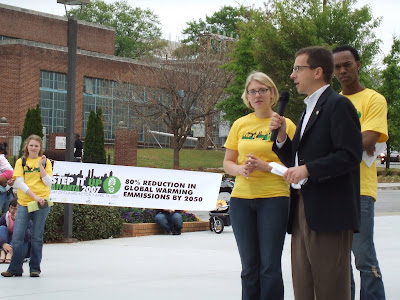
Cynthia Hewitt spoke of the relationship of Global Warming to Social Justice issues.

NaTaki Osborne called on us to be an inclusive movement and take action.
 About 150 people showed up to tell Congress to Step It Up. (Unfortunately we were competing with an Obama rally that drew 20,000.)


 The Grave's Hall Step Team pumped us up with a final performance:
NaTaki Osborne called on us to be an inclusive movement and take action.
About 150 people showed up to tell Congress to Step It Up. (Unfortunately we were competing with an Obama rally that drew 20,000.) The Grave's Hall Step Team pumped us up with a final performance:


Afterwards participants went to the Dogwood Festival and spread the message about climate change!
Thank you volunteers, the steering committee, and sponsoring organizations. For more information about the emerging Climate Coalition, stay tuned to www.stepitupatlanta.org.
Wednesday, February 21, 2007
Climate Change Action Day
Hi everyone,
I'm sorry I've been MIA. I have a good excuse, thought, I got involved in a new project: Bill McKibben's National Day of Climate Action; the "Step It Up" campaign. The basic message is to Congress: to mandate that we reduce our carbon emissions by 80% by 2050. We want media coverage, but mostly we want to build a mass movement, along the lines of the Civil Rights movement, because Congress MUST act.
As of today, there are 713 actions planned across the nation. Here in Atlanta, we are making big plans. We would like to have a rally, and are hoping to get 1000 people there. We haven't determined the location yet, but we want it meaningful and make a splash. I'll update you as we get locations and speakers and activities confirmed.
When Atlanta Beyond Oil decided on our name, we wanted something that would encompass climate change as well as peak oil issues. When this event showed up on our horizon, we were motivated to understand the connections between climate change and peak oil. At our last meeting, we had speakers from the Georgia Interfaith Power and Light, a wonderful organization that works on energy issues with the faith-based community, as well as the Sierra Club's "Cool Cities" campaign.
Both are working with their target communities to support them in taking steps towards decreasing our fossil fuel use.
We also asked our members to read Richard Heinberg's January Museletter on "Bridging Peak Oil and Climate Change," so we could have a discussion. Its a long article, but well worth the read, as it lays out the basic problems that the two communities have to overcome in order to work together. Another article of note is Michael Kare's "Global Warming: It's About Energy."
With our StepItUpAtlanta campaign, we are hoping to build a Climate Coalition. We would like to build bridges between the Peak Oil, Environmental, Social Justice, and EcoJustice, EcoTheological and the new TheoEcological communities. We want to include people from both sides of the aisle, and all demographic groups.
We need to articulate these connections--what does peak oil and climate change have to do with human rights? As well as bring home what we can learn from Katrina--basically, that the status quo is NOT adequate to the challenge.
The future of our planet is at stake!
This morning the Step It Up Atlanta organizing committee had our fourth meeting. We really wanted to get as many groups as possible to the table, so that we could get input on our program. We brainstormed on our vision, values, and message that we wanted to send with our events. We discussed where to have the rally. We also broke out into task groups: Organizational Outreach, Logistics, Program, Publicity, and Finance. It takes a lot to put together an event, especially of the size we are hoping for!
Your's truly is the head of the Logistic team. This means glamorous things like porta-potties. But hey, some body's got to do it!
Anyway I'll keep you posted on the developments. And I encourage you to have your own action in your own community. It doesn't have to be elaborate. The point is to take an irrisitable picture for the media. Here are some ideas.
I'm sorry I've been MIA. I have a good excuse, thought, I got involved in a new project: Bill McKibben's National Day of Climate Action; the "Step It Up" campaign. The basic message is to Congress: to mandate that we reduce our carbon emissions by 80% by 2050. We want media coverage, but mostly we want to build a mass movement, along the lines of the Civil Rights movement, because Congress MUST act.
As of today, there are 713 actions planned across the nation. Here in Atlanta, we are making big plans. We would like to have a rally, and are hoping to get 1000 people there. We haven't determined the location yet, but we want it meaningful and make a splash. I'll update you as we get locations and speakers and activities confirmed.
When Atlanta Beyond Oil decided on our name, we wanted something that would encompass climate change as well as peak oil issues. When this event showed up on our horizon, we were motivated to understand the connections between climate change and peak oil. At our last meeting, we had speakers from the Georgia Interfaith Power and Light, a wonderful organization that works on energy issues with the faith-based community, as well as the Sierra Club's "Cool Cities" campaign.
Both are working with their target communities to support them in taking steps towards decreasing our fossil fuel use.
We also asked our members to read Richard Heinberg's January Museletter on "Bridging Peak Oil and Climate Change," so we could have a discussion. Its a long article, but well worth the read, as it lays out the basic problems that the two communities have to overcome in order to work together. Another article of note is Michael Kare's "Global Warming: It's About Energy."
With our StepItUpAtlanta campaign, we are hoping to build a Climate Coalition. We would like to build bridges between the Peak Oil, Environmental, Social Justice, and EcoJustice, EcoTheological and the new TheoEcological communities. We want to include people from both sides of the aisle, and all demographic groups.
We need to articulate these connections--what does peak oil and climate change have to do with human rights? As well as bring home what we can learn from Katrina--basically, that the status quo is NOT adequate to the challenge.
The future of our planet is at stake!
This morning the Step It Up Atlanta organizing committee had our fourth meeting. We really wanted to get as many groups as possible to the table, so that we could get input on our program. We brainstormed on our vision, values, and message that we wanted to send with our events. We discussed where to have the rally. We also broke out into task groups: Organizational Outreach, Logistics, Program, Publicity, and Finance. It takes a lot to put together an event, especially of the size we are hoping for!
Your's truly is the head of the Logistic team. This means glamorous things like porta-potties. But hey, some body's got to do it!
Anyway I'll keep you posted on the developments. And I encourage you to have your own action in your own community. It doesn't have to be elaborate. The point is to take an irrisitable picture for the media. Here are some ideas.
Sunday, December 31, 2006
New Year's Resolutions
Happy New Year everyone!
This year I am setting some "SMART" goals, that is goals that are specific, measurable, attainable, realistic and tangible.
This year I am setting some "SMART" goals, that is goals that are specific, measurable, attainable, realistic and tangible.
Assess my starting point:
- Calculate my ecological footprint for 2006 (using calculators here, here and here.)
- Measure the killowatts my appliances consume using the Kill-a-Watt meter.
Set targets for reducing my footprint in 2007:
- Honor my pledge to reduce my fossil fuel consumptions by 2.6% based on the recommendations of the Oil Depletion Protocol.
- Find out what the recommendations are for reducing my carbon footprint to prevent global warming.
- Meet that goal with a combination of emissions reduction and offsets.
Set up a way to track my progress:
- Make a spreadsheet with all the variables.
- Set up a timetable for when to measure my results.
- Track cumulative numbers and percentages to see if I am on target.
Be accountable:
- Post my goals (in terms of percentages).
- Post my progress (in terms of percentages).
- Network with other people who are doing the same and offer my support.
I invite you to join me! Together we can make a difference.
Sunday, December 17, 2006
Gifts for the adults on your list (Cross posted on Groovy Green)
Groovy Green's 12 Days of Christmas
"Green Gifts for the Adults on Your List"
by Liz Logan
Okay. It's December 17th. Hanukkah has started, Christmas is in eight days, which puts the Solstice at four days from now and Kwanza at nine. No matter how you slice it, you are running out of shopping time.
Of course your ideal would be to buy local and not spend precious fuel to ship to loved ones far away. All the better if you can take public transit to shop!
But if you have to ship, you can ease your conscious by shopping on line with green vendors. But where to start? Never fear! Your intrepid Groovy Green personal shopper, Liz Logan, has done a bit of surfing and has rounded up some green selections for you. As Bo Derek put it: "Whoever said money can't buy happiness simply didn't know where to go shopping."
Let's get right to the point:
For Him—always the hardest on the list, right? But I've got you covered.
Does he travel? Live in a dorm? Or does he spend the night at his girlfriend/boyfriend's apartment? Then check out BTC Elements' men's toiletries kit, made out of recycled billboards.
You know that vague disappointed feeling when you open up a "container" gift and there is nothing in it but tissue paper? So to avoid that, fill it with this: Grass Roots organic Druide Travel Kit .
Want to keep him stylishly warm and cozy? Then check out the totally cool fleece hats made out of recycled plastic from Cagoule Fleece.
And for the party animal in him, how about a organic beer sampler from Eco Express? Cheers!
But If he's a teetotaler, then check out the organic tea at Diamond Organics.
For Her—we'll start with the jewelry, as that is my personal favorite:
If you're going in circles you're on the right track. Circles are THE fashion motif this year! Add Chakra gemstones plus a 15% discount and you can't go wrong! At Shanti Boutique.
Romance on your mind? Maybe even planning to pop the question? How about gemstones with a conscious: Leber Jeweler, Inc.
Does she keep that beautiful body in shape with yoga? Show your appreciation with this colorful batiked yoga bag from Global Mamas to carry her mat in.
Nurture your special woman with the "Walk A Mile In My Shoes" holiday gift pack, available through Hope for Women until December 20th.
For the Couple—two birds with one stone!
Everybody can use compact fluorescent light bulbs; and don't just look for them at your big box stores, lots of local businesses are starting to carry them as well. On your card, tell the recipients that they will be saving 10 to 15 times the energy of an incandescent bulb. As "light" is the theme for both Hanukkah and Christmas, you have a great excuse to increase the energy efficiency in their homes!
For rechargeable batteries of all types, check out Green Batteries.
You're the practical type? Give them green household necessities. Check out this option at Green Home.
Everybody could use these economical grocery bags form Abundant Earth. Get some for yourself while you are at it!
Have they recently combined households? Gotten hitched? Looking for a hostess gift? Consider this selection of recycled Holiday glassware at Green Glass.
Do you know their taste, and want to get them the perfect object d'art? Check out National Geographic's Novica site. It might take a couple of weeks to get your item, however.
Haven't a clue about what they'd like? Here are some sure fire winners:
· Romantic Dinner for Two from Eco Express
· Organic Wine from the Organic Wine Company.
· Rainforest Munch from Eco Express.
· Organic Herbal Wreath from Eco Express.
For Anybody:
For the person who has everything: give him or her their own private ecosystem! The EcoSphere from Abundant Earth.
Hip & Zen has a lot of cool stuff, but check out this organic neck hugger that warms you neck and smells good.
And there is a great selection of Organic Gift Baskets from Diamond Organics.
And if all else fails, you can't go wrong with organic flowers from Organic Bouquet, or California Organic Flowers, Great sites to bookmark for year-round giving!
Okay, if you STILL haven't found something, then check out these gift guides and directories:
· Green Gift Guide has lots of ideas.
· The Green Guide has several free articles.
· Novica gift guide for beautiful Fair Trade items.
· Local Harvest store has lots of goodies.
· Greenpeople Directory which allows you to search different categories by your location.
Thanks for helping to make this a Green Holiday Season!
"Green Gifts for the Adults on Your List"
by Liz Logan
Okay. It's December 17th. Hanukkah has started, Christmas is in eight days, which puts the Solstice at four days from now and Kwanza at nine. No matter how you slice it, you are running out of shopping time.
Of course your ideal would be to buy local and not spend precious fuel to ship to loved ones far away. All the better if you can take public transit to shop!
But if you have to ship, you can ease your conscious by shopping on line with green vendors. But where to start? Never fear! Your intrepid Groovy Green personal shopper, Liz Logan, has done a bit of surfing and has rounded up some green selections for you. As Bo Derek put it: "Whoever said money can't buy happiness simply didn't know where to go shopping."
Let's get right to the point:
For Him—always the hardest on the list, right? But I've got you covered.
Does he travel? Live in a dorm? Or does he spend the night at his girlfriend/boyfriend's apartment? Then check out BTC Elements' men's toiletries kit, made out of recycled billboards.
You know that vague disappointed feeling when you open up a "container" gift and there is nothing in it but tissue paper? So to avoid that, fill it with this: Grass Roots organic Druide Travel Kit .
Want to keep him stylishly warm and cozy? Then check out the totally cool fleece hats made out of recycled plastic from Cagoule Fleece.
And for the party animal in him, how about a organic beer sampler from Eco Express? Cheers!
But If he's a teetotaler, then check out the organic tea at Diamond Organics.
For Her—we'll start with the jewelry, as that is my personal favorite:
If you're going in circles you're on the right track. Circles are THE fashion motif this year! Add Chakra gemstones plus a 15% discount and you can't go wrong! At Shanti Boutique.
Romance on your mind? Maybe even planning to pop the question? How about gemstones with a conscious: Leber Jeweler, Inc.
Does she keep that beautiful body in shape with yoga? Show your appreciation with this colorful batiked yoga bag from Global Mamas to carry her mat in.
Nurture your special woman with the "Walk A Mile In My Shoes" holiday gift pack, available through Hope for Women until December 20th.
For the Couple—two birds with one stone!
Everybody can use compact fluorescent light bulbs; and don't just look for them at your big box stores, lots of local businesses are starting to carry them as well. On your card, tell the recipients that they will be saving 10 to 15 times the energy of an incandescent bulb. As "light" is the theme for both Hanukkah and Christmas, you have a great excuse to increase the energy efficiency in their homes!
For rechargeable batteries of all types, check out Green Batteries.
You're the practical type? Give them green household necessities. Check out this option at Green Home.
Everybody could use these economical grocery bags form Abundant Earth. Get some for yourself while you are at it!
Have they recently combined households? Gotten hitched? Looking for a hostess gift? Consider this selection of recycled Holiday glassware at Green Glass.
Do you know their taste, and want to get them the perfect object d'art? Check out National Geographic's Novica site. It might take a couple of weeks to get your item, however.
Haven't a clue about what they'd like? Here are some sure fire winners:
· Romantic Dinner for Two from Eco Express
· Organic Wine from the Organic Wine Company.
· Rainforest Munch from Eco Express.
· Organic Herbal Wreath from Eco Express.
For Anybody:
For the person who has everything: give him or her their own private ecosystem! The EcoSphere from Abundant Earth.
Hip & Zen has a lot of cool stuff, but check out this organic neck hugger that warms you neck and smells good.
And there is a great selection of Organic Gift Baskets from Diamond Organics.
And if all else fails, you can't go wrong with organic flowers from Organic Bouquet, or California Organic Flowers, Great sites to bookmark for year-round giving!
Okay, if you STILL haven't found something, then check out these gift guides and directories:
· Green Gift Guide has lots of ideas.
· The Green Guide has several free articles.
· Novica gift guide for beautiful Fair Trade items.
· Local Harvest store has lots of goodies.
· Greenpeople Directory which allows you to search different categories by your location.
Thanks for helping to make this a Green Holiday Season!
Sunday, December 03, 2006
How can we assess "sustainability?"
On Friday, December 1st I went to Southface's monthly breakfast roundtable and learned how organizations are designing and implementing sustainability principles.
So what do I mean when I say something is "sustainable?" I like the definition which says it is a practice which could be continued indefinitely without any degradation to the environment or future generations. In Native American tradition, for example, every decision would be weighed based on its impact on the next seven generations.
The first speaker, Susan Garrett, told us about The Natural Step. She has studied it extensively in Sweden, where it originated. The Natural Step is a methodology for assessing the sustainability of something. The criteria were developed over a period of 15 years by scientists who kept refining what they call the "system conditions"--the conditions that are necessary for a society to be sustainable.
She gave an example of how she was applying the principles to an upcoming conference. It is being held at a major hotel. She focused on how they were going to feed everybody. Ideally, it would be with local, organic, and affordable food. So the first thing that she did was call Georgia Organics. The farmers told here that there wasn't a lot of surplus crops available in March--but she could have all the kale she wanted. So that was the first "aha." Gatherings mean mouths to feed, and so there is a reason to pay attention to the seasons. The second aha came when she explained what the farmers said about the animals. 100 pork loins means slaughtering 50 pigs. Couldn't they use the whole animal? But of course the kitchen wasn't set up for that.
One of the goals of doing this assessment is to figure out how to "build capacity" for the future when you come up against such systemic blocks. So in this case, it would mean rethinking the scheduling and the food processing. What would it take for the chefs to create a menu that used the whole animal? And to change the expectations of the diners, as well?
The second speaker, Paula Vaughn, shared what her architectural firm, Perkins + Will have done towards their goal of becoming the greenest design firm on the planet. She gave us a brief tour of their Green Operations Plan, which covers:
So what do I mean when I say something is "sustainable?" I like the definition which says it is a practice which could be continued indefinitely without any degradation to the environment or future generations. In Native American tradition, for example, every decision would be weighed based on its impact on the next seven generations.
The first speaker, Susan Garrett, told us about The Natural Step. She has studied it extensively in Sweden, where it originated. The Natural Step is a methodology for assessing the sustainability of something. The criteria were developed over a period of 15 years by scientists who kept refining what they call the "system conditions"--the conditions that are necessary for a society to be sustainable.
She gave an example of how she was applying the principles to an upcoming conference. It is being held at a major hotel. She focused on how they were going to feed everybody. Ideally, it would be with local, organic, and affordable food. So the first thing that she did was call Georgia Organics. The farmers told here that there wasn't a lot of surplus crops available in March--but she could have all the kale she wanted. So that was the first "aha." Gatherings mean mouths to feed, and so there is a reason to pay attention to the seasons. The second aha came when she explained what the farmers said about the animals. 100 pork loins means slaughtering 50 pigs. Couldn't they use the whole animal? But of course the kitchen wasn't set up for that.
One of the goals of doing this assessment is to figure out how to "build capacity" for the future when you come up against such systemic blocks. So in this case, it would mean rethinking the scheduling and the food processing. What would it take for the chefs to create a menu that used the whole animal? And to change the expectations of the diners, as well?
The second speaker, Paula Vaughn, shared what her architectural firm, Perkins + Will have done towards their goal of becoming the greenest design firm on the planet. She gave us a brief tour of their Green Operations Plan, which covers:
- transportation (both commute and company fleet)
- office water use
- office energy use
- office consumables
- indoor air quality
- office renovations and new construction
They did away with most of their fleet, and have mandated buying hybrids in the future. They are replacing all of their plumbing fixtures with low-flow models, and have made substantial savings. Energy use starts with educating people--for example, turn of the computers, turn off the overhead lights, turn on the task lights.
Office consumables has been their biggest challenge. They still use a lot of paper, but now print everything they can on both sides, and make that a criteria for any new printers and plotters. They bought a tester for indoor air quality, and the results of that will drive their decisions in the future. And finally, the same principles they apply to their clients' projects, they will apply to their own.
In the Q&A afterwards, somebody said that when they compared the impact of a ceramic cup to a consumable cup, they discovered that you would have to use the cup over a thousand times before it "broke even." Vaughn said that they had many points of view in this category, but that they did do things like include the dishwasher, detergent and hot water in their calculations. Garrett pointed out that if you used the Natural Step criteria, anything that put pollutants out (like manufacturing Styrofoam) would be automatically discarded.
So my understanding of "what is sustainable?" has gotten bigger and more complex. I am starting to understand that there are no absolutes, that each choice has to be weighed. And this of course includes the human systems, both external and internal.
I am grateful for this opportunity to hear what others are doing, and am excited about learning how to apply these principles to my own life.
Thursday, November 23, 2006
Thanksgiving

Now that I've gotten through most of my grief about peak oil, I have discovered a quality of poignancy in my life. Almost every night, as I snuggle under the covers, I give thanks for my warm house, for my meds, and for the power that turns on the TV, phone, and computers. I am grateful for my car and the gasoline to drive it, the food in the grocery store, and the roads that enable me to get there.
I believe that a time will come when I won't have such luxuries, so I try to appreciate them as much as possible while I have them.
Then when the accouterments of civilization are gone, what will we have left? Each other.
In the mean time, I am so grateful for the peak oil community, that I am slowly getting to know. I am grateful for the oil professionals that put their careers on the line so that we would learn about the problem. I am grateful for the people that took this understanding and have made it their life's work to educate the public and support us in preparing for it. I am grateful for the grass-roots activists who are making changes. I am grateful for you.
I believe that a time will come when I won't have such luxuries, so I try to appreciate them as much as possible while I have them.
Then when the accouterments of civilization are gone, what will we have left? Each other.
In the mean time, I am so grateful for the peak oil community, that I am slowly getting to know. I am grateful for the oil professionals that put their careers on the line so that we would learn about the problem. I am grateful for the people that took this understanding and have made it their life's work to educate the public and support us in preparing for it. I am grateful for the grass-roots activists who are making changes. I am grateful for you.
Thursday, November 02, 2006
Strategic Planning
Hi everyone,
I have been in action mode, but I hope to start capturing what I am learning and sharing it here. I have a lot to tell about our big event, hosting Richard Heinberg October 11th, but the first thing I want to do with that is to write up a "best practices" document so that we (and others) can benefit from our experience.
My latest activities have been related to our oil awareness Meetup group, Atlanta Beyond Oil. I have been preparing for our Heinberg event debrief meeting, our "new members" meeting, and in the process of that, have done some strategic planning. I wrote out my thinking so that I could get clearer about it, and also so I could talk to other people who know more about Atlanta and Georgia and politics and environmental groups, etc. and get feedback. So this is just a first draft.
Out basic goal is to get the Peak Oil message out, and so far we have considered three audiences: state and local government officials, environmental groups, and the general public. There is also the realm of education, K through 12 and beyond. And then there are the powers behind everything else, the corporations. But I wasn't ready to tackle those yet.
Ultimately we want an "energy literate" government and society.
STATE AND LOCAL GOVERNMENT
Specifically, mayors, city councils, county commissioners, state representatives, state senate, the governor, and all the relevant committees associated with these.
Goals:
• Pass peak oil resolutions as they did in San Francisco and Portland (but de-emphasize that it's a West Coast thing)
• Start committees to do assessment on energy needs, food needs, transportation needs (including citizens)
• Produce reports about these with recommendations
• Draft policies, lobby for them, get them passed (unless we go the 501 (c)(3) route, in which case we can't lobby and would partner with a lobbying group)
• Have town hall meetings to raise consciousness about, plan for, and implement preparedness for the coming energy transition
. Develop tax credits, system benefits plan, economic development plans that support preparedness
Strategies:
• Educate local officials
• Find sponsors who will champion our cause
• Hold Open Space Technology meetings for citizens and/or officials to develop areas of focus, groups who will work on them, and action plans
• Use templates to develop plans for assessment (Powerdown Project, Kinsale, Willits, new PCI book, etc.)
• Develop teams that can write policy recommendations (partner with local groups and take advantage of national resouces)
• Get public support for these policies
. Work with GEFA
. Work with GDOT
Tactics:
• Develop ABO team to work in this area
• Continue to lobby contacts we have made so far
• Develop speakers bureau
• Make presentations to committees, etc
• Track GA Energy Strategy Plan and input when possible
• Join the Relocalization Network
• Get advice from folks in other groups who are working on this
• For generating public support, see that category
ENVIRONMENTAL GROUPS
Specifically: (at this point I don't want to mention our target groups by name)
Goals:
• Have peak oil be a part of the discourse (especially along with climate change)
• Build an Energy Transition Coalition (both climate change and peak oil require us to make a transition to non-fossil fuel energy)
• Have ratifying the Oil Depletion Protocol be part of the agenda
Strategies:
• Get buy in on the idea that peak oil must be addressed when climate change issues are addressed
. Develop partnerships with other groups
• Invite groups to come to an OST on energy transition
• Invite groups to co-sponsor an OST on energy transition
• Invite groups to join the coalition
Tactics:
• Join GEC
. Do a needs-gap analysis
. Identify target groups, starting with those concerned with climate change
• Identify key contacts
• Meet with key contacts
• Explain how peak oil relates to climate change, especially the coal issue
• Explain how the ODP compliments the Kyoto Protocol
• Develop presentations and materials for environmental groups
. Swap presentations
• Distribute ODP book and Oil Poster
GENERAL PUBLIC
Goals:
• Vote for peak oil aware officials
• Support their officials to make peak oil preparedness policies
• Form committees to do assessments, plan, and take action for preparedness
• Take action for personal preparedness
• Participate in community-wide preparedness actions
• Have many groups like ours throughout the metro area and state wide
• Reduce energy use by 2.5% per year
• Participate in local food production
• Etc.
Strategies:
• Let the public know which officials are peak oil aware
• Campaign for policies
• Share resources and how to prepare on our website
• Have OST meetings for people to come together, create teams, and work on preparedness
• Have seminars where they can learn what other communities are doing
• Have seminars where they can learn how to personally prepare
• Tell them how to do assessments of their own energy consumption or who to hire
• Promote the ODP
Tactics:
• Have showings of End of Suburbia and the Cuba film (Kilowatt Ours too?)
• Bring in name speakers (partner with other environmental groups)
• Participate in events (Bioneers , Earth Day, etc)
• Work with “candidate scorecard” groups to have their criteria include peak oil aware
• Develop education, training, and PR materials
• Create a marketing plan
• Work with other PO groups to develop resources (“how to” manuals, etc)
• Join the Relocalization Network
• Network with Green professionals to develop a resources list
DEVELOP ATLANTA BEYOND OIL
Specifically, leadership, core group, casual members, non-participating members, committees (standing and ad hoc)
Goals:
• Clear purpose
• Clear leadership
• Clear vision
• Clear community
• Clear management
• Clear goals
• Enough active members to sustain projects without burn out
• Standing committees
• Community events
Strategies:
• Schedule gathering(s) to explore purpose, leadership, vision, community and management
• Promote our group
• Ask members for feedback on what they want
• Have internal OST to create committees and action plans
• Capture what we learned from the Heinberg event (write “best practices” document)
• Develop leadership skills of each member
Tactics:
• Have additional meetings on the weekends
• Advertise meetings
• Develop website
• Develop identity
• Create data base of members
• Take a survey
• Debrief Heinberg
Thursday, October 12, 2006
Introducing Richard Heinberg: Atlanta October 11th, 2006
Welcome to Peak Oil: Challenges and Opportunities at the end of Cheap Petroleum--a presentation by Richard Heinberg. My name is Liz Logan, and I am the Organizer for Atlanta Beyond Oil.
If you would have told me eighteen months ago that I would be standing here introducing Richard Heinberg, I would have said you were crazy. When my friends first told me about peak oil, I stuck my fingers in my ears and said "la, la, la, I can't hear you!" I was totally resistant to the idea.
Since I started my peak oil journey, I discovered that people had all kinds of crazy reactions. People told me that they sat at the computer for months reading everything they could find about it, or they began to obsessively make lists of all the supplies that they would need to stock up on.
As we shared our stories, something became obvious to us. Learning about peak oil can have a profound effect on your life. It requires you to rethink things that you may have taken for granted.
It is not a comfortable process. For some of us it meant dusting off our critical thinking skills and learning to read graphs and get comfortable with numbers. For others it meant going through an emotional upheaval.
And ultimately, we are all faced with the question: what can we do to prepare for the energy transition?
No matter where you are in your journey, whether this is your first introduction or you have been grappling with this for a while, you will get something out of Richard's presentation tonight. He will explain the problem, but also offer a solution.
Richard has dedicated his life to increasing the energy literacy of our nation. He has written seven books that have been translated into seven languages. We are offering three of them for sale. They include:
1 The Party's Over: War and the Fate of Industrial Societies. This gives some scientific background about peak oil. The latest edition has been substantially revised.
2 Powerdown: Options and Actions for a Post-Carbon World, which lays out the paths that are before us and the consequences of each choice. It is his most political book.
3 His latest book is The Oil Depletion Protocol: A Plan to Avert Oil Wars, Terrorism, and Economic Collapse. It explains the Oil Depletion Protocol, which he will tell you about tonight.
Richard is not only an author, he is also a journalist, educator, editor, lecturer and a Core Faculty member of New College of California. He teaches a course on "Culture, Ecology and Sustainable Community."
He is featured in the film The End of Suburbia, which is many people's introduction to peak oil. He's appeared on national radio and television in eight countries, and has been quoted in Time Magazine, Reuters, and the Associated press. Last month, in a profile in the New Yorker, Bill Clinton told the reporter that he was reading Richard's book The Party's Over.
Richard is also my hero. We are thrilled to have him here and delighted that you could attend.
Please join me in welcoming--Richard Heinberg.
If you would have told me eighteen months ago that I would be standing here introducing Richard Heinberg, I would have said you were crazy. When my friends first told me about peak oil, I stuck my fingers in my ears and said "la, la, la, I can't hear you!" I was totally resistant to the idea.
Since I started my peak oil journey, I discovered that people had all kinds of crazy reactions. People told me that they sat at the computer for months reading everything they could find about it, or they began to obsessively make lists of all the supplies that they would need to stock up on.
As we shared our stories, something became obvious to us. Learning about peak oil can have a profound effect on your life. It requires you to rethink things that you may have taken for granted.
It is not a comfortable process. For some of us it meant dusting off our critical thinking skills and learning to read graphs and get comfortable with numbers. For others it meant going through an emotional upheaval.
And ultimately, we are all faced with the question: what can we do to prepare for the energy transition?
No matter where you are in your journey, whether this is your first introduction or you have been grappling with this for a while, you will get something out of Richard's presentation tonight. He will explain the problem, but also offer a solution.
Richard has dedicated his life to increasing the energy literacy of our nation. He has written seven books that have been translated into seven languages. We are offering three of them for sale. They include:
1 The Party's Over: War and the Fate of Industrial Societies. This gives some scientific background about peak oil. The latest edition has been substantially revised.
2 Powerdown: Options and Actions for a Post-Carbon World, which lays out the paths that are before us and the consequences of each choice. It is his most political book.
3 His latest book is The Oil Depletion Protocol: A Plan to Avert Oil Wars, Terrorism, and Economic Collapse. It explains the Oil Depletion Protocol, which he will tell you about tonight.
Richard is not only an author, he is also a journalist, educator, editor, lecturer and a Core Faculty member of New College of California. He teaches a course on "Culture, Ecology and Sustainable Community."
He is featured in the film The End of Suburbia, which is many people's introduction to peak oil. He's appeared on national radio and television in eight countries, and has been quoted in Time Magazine, Reuters, and the Associated press. Last month, in a profile in the New Yorker, Bill Clinton told the reporter that he was reading Richard's book The Party's Over.
Richard is also my hero. We are thrilled to have him here and delighted that you could attend.
Please join me in welcoming--Richard Heinberg.
Sunday, October 01, 2006
Report on the Energy Transition Summit in CA
I have a report from someone who went to the recent Energy Transition Summit. She is relatively new to the information about peak oil, so looks at this event with fresh eyes. She writes:
Thanks very much Sonja B. ! And she brings up a good point--how do we communicate what we are about in just a few words? We need to bridge the gap between jargon and mainstream.I learned from your blog that your group in Atlanta, GA is sponsoring a speech by Richard Heinberg, so I attended an event to hear him.
On Friday, Sep 29th Richard Heinberg was the keynote speaker at the Energy Transition Summit in Santa Rosa, CA. His speech was well illustrated on the screen and seamlessly presented. He simplified a complex subject and made a concise presentation in a clear and articulate manner which saved me many hours of reading and study. His presentation was factual, but his concluding statements about the dire consequences to ourselves and the planet were passionate and motivating. He received a standing ovation.
- Ann Hancock spoke for the Climate Protection Campaign and was a panelist.
- Larry Robinson was a panelist representing Sebastopol, CA city council.
- Jason Bradford was a panelist representing WELL: Willits Economic Localization.
- Julian Darley was a panelist representing Post Carbon Institute.
- Deborah Lindsay was a panelist and Peak Oil Educator.
There were about 150 people in the audience who spoke to each other in interactive dyads and who submitted written questions to the panel. There were many sponsors. Some were vendors and had informational tables.
Lead Sponsors:
- Energy Transition Team
- Leadership Institute for Ecology and the Economy, ,
- Sonoma County Climate Protection Campaign,
- PG&E,
- the Livability Project, and
- Whole Foods.
The panelist had good information about what each of their groups is doing. They encouraged others to get people involved by being positive, to be enthusiastic, and to tell people how much fun it is to work with a wonderful group of new friends.
I personally think that's all good, rather than scaring people, which is probably a turn off, but hardly anyone I know knows what Peak Oil means and the titles of events, books, organizations, committees and groups don't help to explain. The names and titles are meaningful to people already involved, but are cryptic to others. We need a few catchy words to capture the imagination of those not in the know so they will attend an Energy Transition Summits like the one in Santa Rosa and hear Peak Oil explained by Richard Heinberg and the other participants.~Sonja B.
Heinberg on Peak Oil: Challenges and Opportunities at the End of Cheap Petroleum
Modern civilization is dependent on cheap, plentiful energy. But we now face a critical moment in human history: Peak Oil, where global petroleum production enters an irreversible decline, even as demand soars. Dwindling resources and increasing international competition for the remaining supplies have led many experts to issue disturbing warnings about the coming decade.
Richard Heinberg, widely regarded as America’s foremost Peak Oil educator, will share the most up-to-date research on the timing and consequences of global peak oil, and the crucial preparations that must be undertaken, both locally and internationally. His new book, The Oil Depletion Protocol, outlines a practical, humane strategy for addressing petroleum’s inevitable decline.
Wednesday, October 11, 2006
7:30 pm
Trinity United Methodist Church
265 Washington Street SW, Atlanta
(opposite City Hall)
Map Directions
$5 suggested donation
($3 for students/seniors)
Richard Heinberg is a journalist, educator, editor, lecturer and a core faculty member at New College of California in San Francisco, where he teaches courses on Energy and Society and Culture, Ecology and Sustainable Community.
His six books include:
The Party’s Over: Oil, War and the Fate of Industrial Societies
Powerdown: Options and Actions for a Post-Carbon World
The Oil Depletion Protocol: A Plan to Avert Oil Wars, Terrorism and Economic Collapse
Heinberg’s essays and articles have appeared in many journals and he has given over 200 lectures on oil depletion to a wide variety of audiences. He appears prominently in the documentary The End of Suburbia.
This event is sponsored by Atlanta Beyond Oil,a local organization dedicated to preparing for a changed energy world.
For information, email info@atlantabeyondoil.org
Checkout our Meetup website.
Bicycling, public transportation or walking to this event is encouraged!
Richard Heinberg, widely regarded as America’s foremost Peak Oil educator, will share the most up-to-date research on the timing and consequences of global peak oil, and the crucial preparations that must be undertaken, both locally and internationally. His new book, The Oil Depletion Protocol, outlines a practical, humane strategy for addressing petroleum’s inevitable decline.
Wednesday, October 11, 2006
7:30 pm
Trinity United Methodist Church
265 Washington Street SW, Atlanta
(opposite City Hall)
Map Directions
$5 suggested donation
($3 for students/seniors)
Richard Heinberg is a journalist, educator, editor, lecturer and a core faculty member at New College of California in San Francisco, where he teaches courses on Energy and Society and Culture, Ecology and Sustainable Community.
His six books include:
The Party’s Over: Oil, War and the Fate of Industrial Societies
Powerdown: Options and Actions for a Post-Carbon World
The Oil Depletion Protocol: A Plan to Avert Oil Wars, Terrorism and Economic Collapse
Heinberg’s essays and articles have appeared in many journals and he has given over 200 lectures on oil depletion to a wide variety of audiences. He appears prominently in the documentary The End of Suburbia.
This event is sponsored by Atlanta Beyond Oil,a local organization dedicated to preparing for a changed energy world.
For information, email info@atlantabeyondoil.org
Checkout our Meetup website.
Bicycling, public transportation or walking to this event is encouraged!
Saturday, September 23, 2006
Feeling-based learning
I am back from my training with the Genuine Contact program. It was one of those experiences that altered the way I percieve the world in fundamental ways. I changed the way I perceive myself, organizations and meetings. We worked with material that I had encountered before as I got trained to be an adult educator, but I got it at a deeper level. When I have taken learning style or personality type assessment, I tended to test out at a "feeler/intuitive/emotional" type of person. But there are three other orientations as well: the watcher, thinker, and doer.
In the workshop we broke out into groups with people that had a similar orientation to us. Not surprisingly I met with the woman that I had felt most connected to at the workshop. Our assignment was to note what we needed from a facilitator or teacher coming from the perspec tive of our learning style, and we were very excited about having the opportunity to express the experiences of the feeling-based person.
This perspective is not articulated very often, and certainly not in a business context. Feeling-based processes are not usually welcomed. This is a shame because there is a lot of value in getting in touch with one's feelings. With this comes intuition, opening space, "critical feeling," and attending to how things feel. In its broadest application, it is a quality of life issue.
Below are the things that we were able to capture on paper. The minimum requirements that we need from a facilitator/educator:
In the workshop we broke out into groups with people that had a similar orientation to us. Not surprisingly I met with the woman that I had felt most connected to at the workshop. Our assignment was to note what we needed from a facilitator or teacher coming from the perspec tive of our learning style, and we were very excited about having the opportunity to express the experiences of the feeling-based person.
This perspective is not articulated very often, and certainly not in a business context. Feeling-based processes are not usually welcomed. This is a shame because there is a lot of value in getting in touch with one's feelings. With this comes intuition, opening space, "critical feeling," and attending to how things feel. In its broadest application, it is a quality of life issue.
Below are the things that we were able to capture on paper. The minimum requirements that we need from a facilitator/educator:
- Invite feelings into the process. Make it okay to have and express them. Articulate this explicitly. Say it with authenticity.
- Don't be reactive or judgmental when feelings are expressed. Of course if you do have reactions or judgments and then supress them, we will be able to feel that. So if you do have these reactions, it is better to acknowledge and own them. They are not wrong. It is okay. It helps us if they are out on the table.
- Express your acceptance for the feeling side of the spectrum with your body language (nods, eye contact, open posture, etc.)
- Accept your OWN feelings. This is the key to accepting someone else's.
- I need to stop and feel in order to learn and remember. It may take me some time to process. I may need to go away from the learning environment and digest what has been presented to me before I can open to more.
- Learning evokes strong emotions in me sometimes.
- There is a continuous flow of emotions that goes along with the material I am being presented with.
This is not a problem for us, as long as it is not a problem with you. As Jewel wrote "I'm sensitive, and I want to stay that way."
We are very sensitive to the "energy field" of the meeting.
- disturbances in the energy field (denial, judgements) flood us with "distracting" feelings
- we have a hard time attending to learning content if there are funky interpersonal dynamics in the room
- if other people are having an emotional reaction, we usually have an emotional response to that that we need to process
We are sensitive to the fact that emotions and especially their expression do not have a lot of acceptance in many contexts
- we are upset about this, and when this is blatant it triggers our feelings about having our way of being rejected
- we have a lot of energy going into self-monitoring to check our expression so that we will be accepted
- we are very sensitive to whether the emotional orientation has acceptance or not
- situtaions where the people are closed to our orientation can trigger feelings of anger, dispair, self-doubt about our value, guilt about wanting to have acceptance, and on and on
- it is very scary to express our feelings about this
After we posted our flip chart paper we sat on the couch with a blanket over our heads. We felt extremely vulnerable to bring this forward. But it was also very exhilerating to do so.
We also got to learn about the needs of folks with other orientations. That was extremely valuable. I got a better sense of the implications of orientation when designing meetings or lesson plans that included everybody in the room. I need to give time for the watchers to reflect on their experiences. I need to provide data for the thinkers. I need to give the doers something to do.
So what does all of this have to do with the intersection of community and sustainability? For me, everything. These issues/topics have a strong emotional content for me. I want a community that includes emotional processes. I want to allow for emotional responses to the issues that come up when we consider sustainability.
I also want to open space for myself to broaden the content area of my blog. I am feeling more confident that I can simply come from my own point of view and add it to the collective pool of knowledge. That is the beauty of blogs. They provide so many points of view, and when someone is writing from their own place, I learn about theirs and can include it in my holding of the world. I can even broaden my own opint of view.
As an emotionally-based person I often have to go through a range of emotions to get to that magic place of acceptance. I may have to cry, rage, tremble... but this is the healing process, and I am dedicated to following that.
Friday, September 08, 2006
News
I have exciting news! Atlanta Beyond Oil (the new name for our Meetup group) will be hosting Richard Heinberg in Atlanta on Wednesday, October 11, 2006. I'll update you as we get the details nailed down.
So that has been what I've been working on instead of blogging. And I won't be blogging for two more weeks, as I am going to get more facilitation training in the Genuine Contact program. I am really looking forward to working with folks who value the whole person--the intellect and intuition, the mind and emotion, the rational and non-rational sides of us.
Which reminds me, have you seen the Peak Oil Blues website? I think its wonderful that the emotional aspect of confronting Peak Oil is being attended to.
When I get back from this series of workshops I won't be traveling for a while (thank goodness!) so I will be able to get back into my posting groove. I'll talk to you then!
So that has been what I've been working on instead of blogging. And I won't be blogging for two more weeks, as I am going to get more facilitation training in the Genuine Contact program. I am really looking forward to working with folks who value the whole person--the intellect and intuition, the mind and emotion, the rational and non-rational sides of us.
Which reminds me, have you seen the Peak Oil Blues website? I think its wonderful that the emotional aspect of confronting Peak Oil is being attended to.
When I get back from this series of workshops I won't be traveling for a while (thank goodness!) so I will be able to get back into my posting groove. I'll talk to you then!
Saturday, August 26, 2006
Conversations with other Peakers
Our Atlanta Oil Awareness Meetup Group has been having interesting conversations about coming up with our new name, and in the process we are realizing we need to clarify our goals and purpose. Here is my latest contribution to the dialogue: (Plus its an easy post while I am out of town taking care of Dear Great Aunt Lou's stuff. Q: how many margarine containers can one person have? A: I didn't count, but I bet its close to 100!!!)
Here's how I look at this... We have a big problem. What are we going to do about this? And so that begs the question... Who is the "we" that I am talking about? And here are the possibilities...
1) We can respond on the global level, which is doing things like having many nations signing the Oil Depletion Protocol. So how can I as an individual or small group affect this change? It is hard to do much. Each of us can sign the protocol. We can write to our national leaders and ask them to do it. We can ask other individuals to do the same.
2) We can respond on the national level, which is doing things like take the "Apollo Program" approach... Make it a national priority to address this problem, provide the resources, mandate programs, wage a propaganda campaign, etc. So how can I as an individual or small group affect this change? Lobby national leaders. Take it upon ourselves to educate the public. Encourage them to lobby, vote for people who will support that, etc.
3) We can respond on the regional level, which is doing things like convening bioregional conferences, summits, Mayor's initiatives, etc. We can support events that are already happening or start one of our own. On the individual level/small group level? Participate, volunteer, or be part of a team that puts one on.
4) We can respond on the state level, which is working with state government, lobbying, and all that political jazz that I don't know too much about. On an individual/small group level we can network with our government, political machines, advocacy organizations that have a Georgia chapter, etc. On the individual small group level, get involved in state politics and advocacy groups, volunteer, do fundraising, etc.
5) We can respond on a metro level (metro Atlanta) which involves learning about the plethora (is that a word?) of organizations doing regional planning, events (Bioneers for example), etc. Individuals and small groups have a lot of leverage here.
6) We can respond on the local level, (cities and towns) getting involved at the city council level, hold home showings of EOS and the Cuba film, etc. Individuals and small groups have lots of leverage here as well.
Another thing to consider is that we are a metro-level group. We do not yet have the membership to break down into smaller constituencies or build up to the state level. So it makes sense to me to work at the scale that we are at: on the Metro scale. This is where we will have the most effect on the world.
An additional bang for the buck is this is the level where the rubber will meet the road in terms of peak oil preparedness planning. We can't count on the larger scale governmental systems to respond adequately (see Katrina).
The other issues is that in the more dire possibilities, we will ONLY be able to deal with things on the local level because it will be too expensive to have a regional, national or global economy (transportation costs).
So to me, this points to the level of our efforts: the metro level.
One could argue that we could be a group of people who are supporting each other to react on a purely individual level (i.e. survival or head to the hills options) but I don't think that is where this group is at.
This is why I think a focus on "relocalization" is so important and why I want to join the Relocalization Network.
I see us as a small group working on the local (metro) level and networked with other groups working on their local levels. And we need to keep in mind that "relocalization" means different things depending on the scope of the region you are talking about: village, town, city, metro, etc.
###
So that is my current thinking on the issue. Any thoughts?
Here's how I look at this... We have a big problem. What are we going to do about this? And so that begs the question... Who is the "we" that I am talking about? And here are the possibilities...
1) We can respond on the global level, which is doing things like having many nations signing the Oil Depletion Protocol. So how can I as an individual or small group affect this change? It is hard to do much. Each of us can sign the protocol. We can write to our national leaders and ask them to do it. We can ask other individuals to do the same.
2) We can respond on the national level, which is doing things like take the "Apollo Program" approach... Make it a national priority to address this problem, provide the resources, mandate programs, wage a propaganda campaign, etc. So how can I as an individual or small group affect this change? Lobby national leaders. Take it upon ourselves to educate the public. Encourage them to lobby, vote for people who will support that, etc.
3) We can respond on the regional level, which is doing things like convening bioregional conferences, summits, Mayor's initiatives, etc. We can support events that are already happening or start one of our own. On the individual level/small group level? Participate, volunteer, or be part of a team that puts one on.
4) We can respond on the state level, which is working with state government, lobbying, and all that political jazz that I don't know too much about. On an individual/small group level we can network with our government, political machines, advocacy organizations that have a Georgia chapter, etc. On the individual small group level, get involved in state politics and advocacy groups, volunteer, do fundraising, etc.
5) We can respond on a metro level (metro Atlanta) which involves learning about the plethora (is that a word?) of organizations doing regional planning, events (Bioneers for example), etc. Individuals and small groups have a lot of leverage here.
6) We can respond on the local level, (cities and towns) getting involved at the city council level, hold home showings of EOS and the Cuba film, etc. Individuals and small groups have lots of leverage here as well.
Another thing to consider is that we are a metro-level group. We do not yet have the membership to break down into smaller constituencies or build up to the state level. So it makes sense to me to work at the scale that we are at: on the Metro scale. This is where we will have the most effect on the world.
An additional bang for the buck is this is the level where the rubber will meet the road in terms of peak oil preparedness planning. We can't count on the larger scale governmental systems to respond adequately (see Katrina).
The other issues is that in the more dire possibilities, we will ONLY be able to deal with things on the local level because it will be too expensive to have a regional, national or global economy (transportation costs).
So to me, this points to the level of our efforts: the metro level.
One could argue that we could be a group of people who are supporting each other to react on a purely individual level (i.e. survival or head to the hills options) but I don't think that is where this group is at.
This is why I think a focus on "relocalization" is so important and why I want to join the Relocalization Network.
I see us as a small group working on the local (metro) level and networked with other groups working on their local levels. And we need to keep in mind that "relocalization" means different things depending on the scope of the region you are talking about: village, town, city, metro, etc.
###
So that is my current thinking on the issue. Any thoughts?
Thursday, August 17, 2006
Atlanta Oil Awareness
I have been working on several projects for my Atlanta Oil Awareness Meetup Group. I will tell you more about them when we have things a little more solid. But one of the things we are doing is producing a tabletop display. My friend from eleven design is doing our design work.
I have been thinking and reading about branding. If you have checked out the group listing at relocalize.net, you know that there are many takes on the concept of an oil awareness group. I think that "Sustainabile Atlanta" is probably too broad for us right now. I'm leaning towards the simple and straightforward "Atlanta Peak Oil." The folks at Sidney Peak Oil tried to initiate a campaign to get all of the groups to follow that format, but it didn't work. Everyone did their own thing.
Other titles in the running include Atlanta Powerdown, Atlanta Post Carbon Solutions, and Atlanta After Oil. If you have any feedback, ideas or suggestions I'd love to hear them!
I have been thinking and reading about branding. If you have checked out the group listing at relocalize.net, you know that there are many takes on the concept of an oil awareness group. I think that "Sustainabile Atlanta" is probably too broad for us right now. I'm leaning towards the simple and straightforward "Atlanta Peak Oil." The folks at Sidney Peak Oil tried to initiate a campaign to get all of the groups to follow that format, but it didn't work. Everyone did their own thing.
Other titles in the running include Atlanta Powerdown, Atlanta Post Carbon Solutions, and Atlanta After Oil. If you have any feedback, ideas or suggestions I'd love to hear them!
Subscribe to:
Posts (Atom)