Tuesday, November 08, 2005

Field Trip

On Saturday some members of my Oil Awareness Meetup Group had a field trip to Allison's house to see how he had built it to be energy efficient and ecologically friendly. He and his wife own 66 acres, mostly wooded, but with some fields cleared for future livestock and farming. But we'll get to that in a minute. Our tour will start with the inside of the home to see his new Energy Star appliances.


His new fridge uses 75% less kilowatts per month which cuts down its fuel bill to about $4.00.


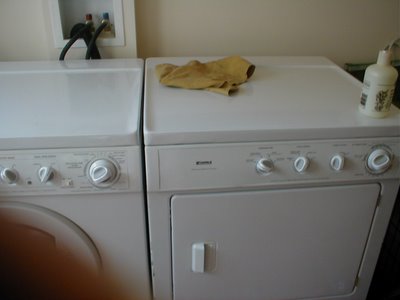
The new washing machine uses much less water per load. Their monthly water usage total is about 440 gallons, or 40% of the average household.


They did a beautiful job tiling the shower, so I had to take a shot of it.

This is their composting toilet. The gasmask is a joke. It has a fan in the tank below which pulls the air out of the bathroom.

This is the waste pipe for the toilet upstairs.

The salvaged the beautiful oak floors from a schoolhouse slated for demolition.

This stove heats the place with downed wood they collect. The house is so well insulated it doesn't take much to get warm. "Pancho" (a plastic Einstein doll) rides atop the cowboy hat.

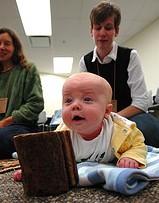
They learned how to set tile on their screened in back porch. We got to meet Hemingway, who is a very friendly 5 month old.

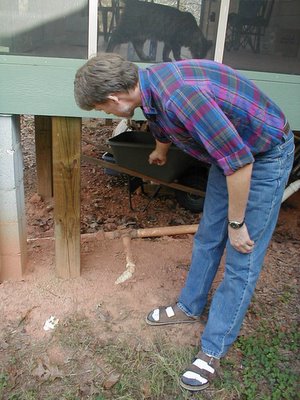
We went out the back door for a look at the graywater system.

It comes out these pipes...

and gets sent to one of the two fields via this valve, which he switches every couple of weeks to let the mulch dry out...

and it comes out of this pipe into the drainage cachement which sends the water to nourish a fruit tree.

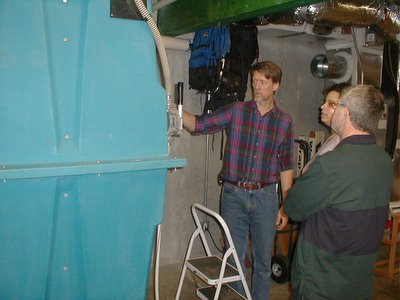
Now its time for a trip to the basement to see the inner workings of the house.

It was built with this insulating material, made of Styrofoam sandwiched between OSB. The ones in the outside walls are about 4" thick and have an R factor of 17. The ones on the roof are thicker.

An airtight house means a ventilation system is needed. When people ask if they will get sick from a well sealed home, Allison responds that a home can't be too tight, just underventilated.

This one exchanges heat between the air going in and going out. The next step up exchanges humidity as well.

This pipe evacuates the radon from underground. Its easy to install if you do it when pouring the slab. The negative air pressure draws radon gas up and out the vent in the roof.

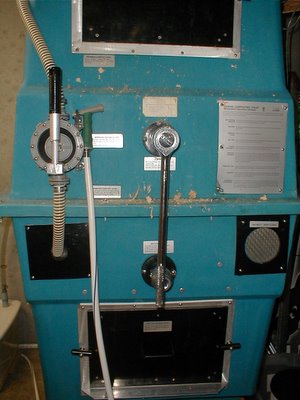
This is the tank of the composting toilet.

The sawdust gets stirred by tines attached to the top axel. The compost comes out of the bottom panel.

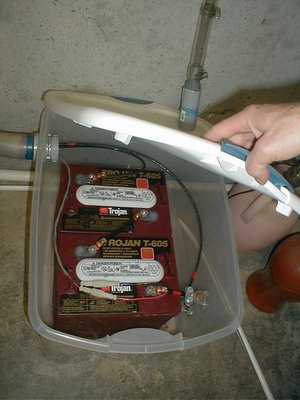
The fan and the light (to attract and kill mold gnats) is on a 12 volt system.

The water pump is also powered by these batteries.

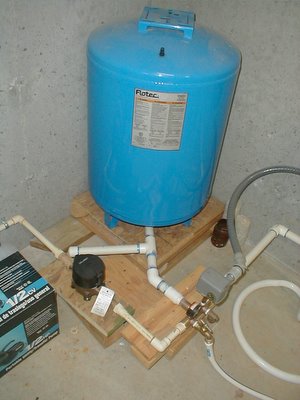
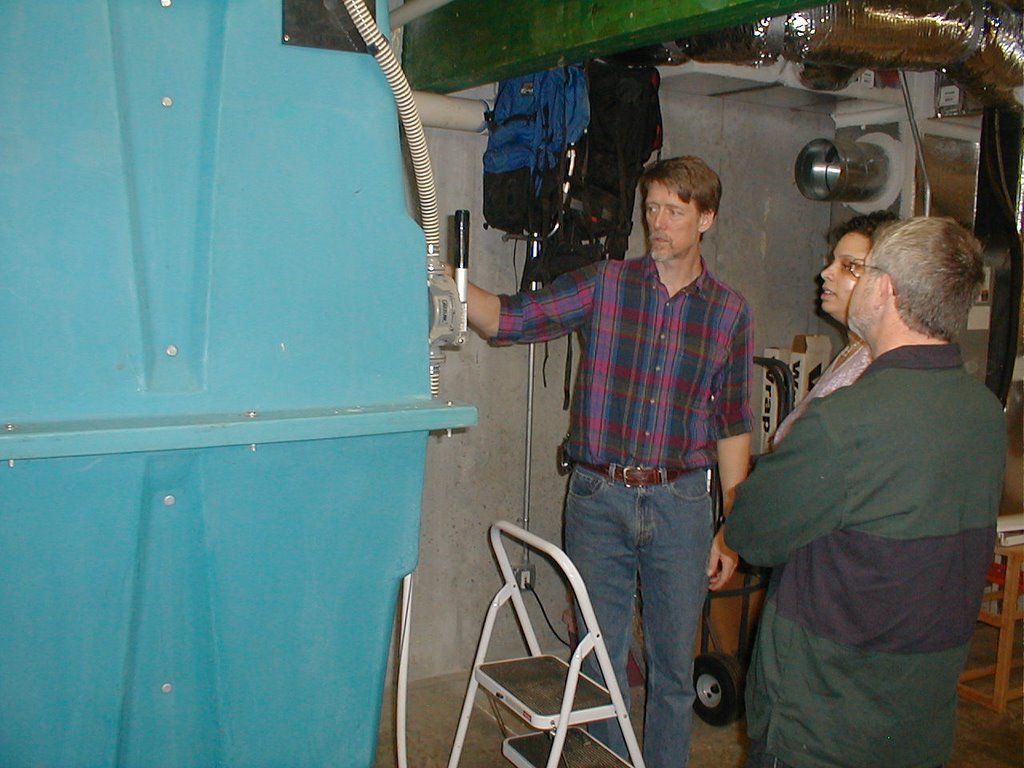
The water is pressurized in this tank.

Now its time to tour the grounds.

The greenhouse.

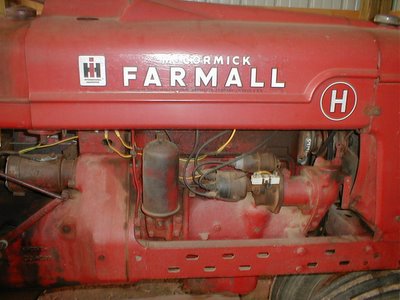
A tractor from the 1940s that they got running with a little TLC and a lot of moola.

My hubby used to ride on one of these growing up on the farm.

Next year this area will have chickens and maybe goats. The mound is their compost pile.

The garden/field is fenced off to protect it from the deer. Apple scented modules lure them and then shocks their noses. They learn to stay away instead of figuring out that they can jump the fence.

The well is 302 feet deep.

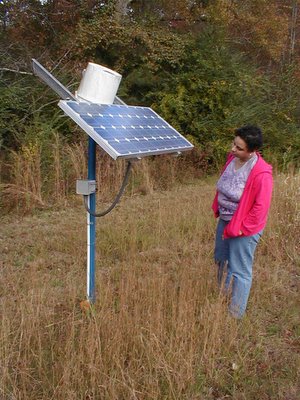
The pump is powered by this solar panel.

We learned a lot and had a great time hanging out. Thanks for your hospitality, Allison, and thanks for coming everyone!

Thursday, November 03, 2005

Three Peak Oil Meetings

The Energy Bulletin posted this article by Aaron Naparstek that helped me define the edges of the peak oil responses and consequently my own place among them. He discusses three events: the "Petrocollapse" Conference, the "Winning the Oil Endgame" town hall, and a NYC Oil Awareness Meetup group.

The Petrocollapse Conference took place in Manhattan on October 5 and it featured speakers such as Jan Lunberg, Michael Ruppert, and James Howard Kunstler. All three are pretty serious "doomers" on the peak oil spectrum and don't put much stock into policy solutions.

If Peak Oil theory is now mainstream, splashed across the front page of USA Today and the theme of Chevron and BP ad campaigns, then Petrocollapse is a secular, left-wing, non-fiction version of Tim LaHaye's Christian Apocalyptic "Left Behind" series. The gospel according to Petrocollapse is that Peak Oil is coming, and it's coming soon. The transition to the post-carbon world will not be gradual, it will be sudden and massive. And when it comes, the sinners--those profligate American consumers and the corporate whores who oversee them--will all be swept away in violent social turmoil, starvation and environmental disaster. But there's good news too. After the tumultuous mass die-off, a new society will arise from the burned out SUV hulks and melted plastic detritus. In this post-carbon world, humans will have no choice but to live sustainably, in cooperation with each other and in harmony with nature. Those who get religion and accept Peak Oil into their hearts soon enough--they may be among the lucky survivors whose children grow to live in this new and better world.
On the other hand, the next event was all about policy.

If the Petrocollapse conference was dominated by conspiracy theorists, then Winning the Oil Endgame" was the Conspiracy. Present on the dais were former CIA director James Woolsey, Mississippi Governor and former Republican National Committee Chairman Haley Barbour, former Deputy Secretary of the Treasury Robert Altman and Amory Lovins, CEO of the Rocky Mountain Institute.

Far from doom and gloom, the Endgame speakers were nearly united in their belief that it was both possible and desirable to keep finding fixes for America's energy Jones and to keep the American consumer machine rolling along using new technologies.
They promoted drilling, nuclear power, coal-fired electricity, natural gas and more efficient vehicles. Little mention was made of the "profound environmental problems and danger" of fossil fuels.

A third perspective was offered by a member of both audiences, Charles Komanoff, "who has been involved in the energy and environmental movements pretty much since they began in the early 1970's."

Komanoff acknowledges the possible validity of the Peak Oil analysis, but having heard similar End Times prophecies thirty years ago, he isn't allowing the Peak Oil argument to guide his work and activism. "I think there's an element of wishful thinking and that some Peak Oil adherents are looking for a deus ex machina to sweep away the disaster that is contemporary industrial civilization," he said. "And understandably so. Waiting for Peak Oil is so convenient, so much simpler, and so much more seductive than the hard work of organizing for social and ecological change."

Komanoff was also critical of the Endgame analysis. "There is a big dissonance between Amory's kind of chirpy optimism and actual realities on the ground and actual energy trends." Three decades after Lovins unveiled his revolutionary "soft energy path," Komanoff points out, the U.S. uses 25% more oil, burns 75% more coal and generates 35% more greenhouse gases than it did in the mid-1970s. Though a 66 mpg SUV is certainly more desirable than Detroit's current state of the art, Komanoff doesn't believe Lovins' hyper car project provides us with real answers for our global energy and environmental quandary because the project is "only about improving the fuel efficiency of the vehicle and does nothing about addressing the social and whole system efficiency of travel and mobility and community."
Finally, Naparstek looks at the NYC Oil Awareness Meetup group. This is the same network that I am involved with so I was particularly interested in how other groups are developing. They deal with the emotional component and have started a subgroup formed to help people get through the paralysis that learning about peak oil brings. Philosophically, they have broken into two approaches: "The Relocalizers believe New York City won't be viable in the age of Peak Oil and are looking for new places to live and new skills to live in a world without modern conveniences. The Sustainable New Yorkers are dedicated to educating and preparing the city for what they see as a lengthy and potentially tumultuous energy crisis."

Despite such dread, there is often a sense of action and possibility at the monthly meeting. Miner makes a point of emphasizing that there are things you can do to prepare for Peak Oil and people interested in doing them with you. At the Meetup, you aren't so much assaulted by the gloomy hopelessness that pervaded the Petrocollapse and Endgame conferences.

In my group, similar distinctions apply. As one member put it, there are "three possible scenarios for the P.O. future, and I can actually argue in support of each:"
1) Nothing Happens (Yergin): Things keep going smoothly (with maybe a slight bump in the road), alternative energy sources are identified in time and the economy will continue to grow at 4% indefinitely-business as usual. The Deniers say, "Everything is fine."

2) Soft Landing (Simmons): The energy crunch causes, at minimum, a recession or possibly a full-blown depression. The US has been through recessions before and will weather this one. A global depression may result as the US economy falters and consumers stop spending but in the end. "We'll tighten our belts and pull through somehow."

3) Hard Landing (Kunstler): The worst case scenario is an economic and social collapse-the stuff of doomsayers' dreams. "Oh shit."

Some Peakniks come in somewhere between 1 and 2, or between 2 and 3. The optimistic 1.5ers see a problem, but believe we can address it-they're the Organizers and Activists. 1.5ers will push for education, political action and programs like carpooling, bike lanes, public transportation, and tax credits for installing solar.

The 2.5ers are the Preparers; they're less optimistic and will be more concerned with readying for a stark, downscaled future-learning about farmsteading and food storage, getting off the grid, learning self defense.

The 3-or-worse crowd (the Survivalists or Apocalyptics) will start hoarding food, buying rural property and stockpiling ammunition like a survivalist. (NOTE: None of these generalizations are intended to be judgmental; everyone has to follow their own instincts.)
We found this to be an interesting starting point in identifying where each of us fell on the spectrum, and hope to create a group that can meet the needs of each.

Saturday, October 29, 2005

(was Flying Talking Donkey)

If you are like me, you are wondering what became of that blog. Well ask no more. Tim of Suburbia is back with links galore at Deat Ants Are My Friends. His selection is as interesting as always. I doodled at the GE's online collaborative whiteboard, added my location to the Peak Oil Frappr map, looked up Preteris, and all around had a good time whileing away the afternoon.

And yes I will update my links!

Wednesday, October 26, 2005

The Slow Crash

This essay by Ran Prieur was posted on Energy Bulletin recently. Its a thoughtful proposition about how things might change, but in a less extreme fashion.
Imagine the end of the world in moderation. It's hard. We tend to imagine that either the "economy" will recover and we'll go on like 1999 forever, plus flying cars, or else one day "the apocalypse happens" and every component of the industrial system is utterly gone.
He denounces the images of people running wild in the streets. He starts out with the question of electricity: "When the lights go out, we won't go berzerk -- we'll go to bed earlier." Gasoline and water are dispatched. Food is more problematic, but he does not believe "the lack of food will make people kill each other." He has plenty of examples to counter that.

...[T]he interesting question is not "How will people die?" but "How will people live?" In the town next to the mass grave, what will we do all day? Process data and feign enthusiasm? Get on the internet? Make crossbows? Tend fruit trees? The best I can figure it out is to look at a bunch of more and less likely modifiers to the world as we know it, and think through how they could change things.
He goes on to look at the effects of various possibilities, including peak oil, economic depression, WWIII, secret weapons, China, serial Falluja, disease, weather, astronomy, and finally, a human consciousness shift.

Interesting reading. And be sure to give the appendixes at the end a look.

Tuesday, October 25, 2005

Medicine Bow


Medicine Bow, where I took the Plant ID course last weekend, is "A primitive school of Earthlore in the North Georgia mountains...that specializes in Native American survival skills (primitive skills) and nature classes. Besides a year round schedule of courses at the school, Medicine Bow carries programs to you on all aspects of Indian lore; such as: using wild plants for food and medicine, tracking, archery, history, canoeing, sign language and other facets of environmental education."

We learned about identifying plants Saturday morning and then spent the rest of the weekend traipsing around the beautiful Appalachian ecosystem looking at plants and learning about their gifts. We harvested tubers and nuts and Sunday afternoon we cooked them up and sampled them. I found out I loved Solomon Seal. We have lots of acorns on our property so I was interested in preparing them as well. We even learned how to make rope. Saturday night he offered an introduction to Native American sign language.

Mark Warren, the owner and our guide had a wonderful presence informed by the Cherokee world view. We learned to respect the "Standing People" (as the Cherokee call the trees and plants) and appreciate what they have to offer us. It was a very nurturing way to address survival issues.

If you live out in this neck of the woods, I highly recommend it.

Friday, October 21, 2005

Plant Identification Course

This weekend I will be taking the first in what I hope to be a series of basic survival courses. So far my peak oil education has included basic first aid from the Red Cross, group facilitation from Communities at Work and this Plant Identification course from Medicine Bow. I'll tell you more when I get back. Have a safe weekend!

Thursday, October 20, 2005

Groups taking action

I am of the opinion that while we each need to take individual action to prepare ourselves for an uncertain future, our ultimate survival will depend on how well our communities function. So I am very heartened whenever I hear of groups and communities coming together to address the challenges. Here are some links to homepages of some of these groups.

http://www.oilposter.org/ (Produced by the San Francisco Oil Awareness Meetup group)
Colorful and authoritative, this poster traces the history of the Oil Age from its beginnings in the hills of western Pennsylvania in 1859 to its rise as the engine of global industrial economies. The poster's main chart features a year-by-year rendering of worldwide oil production from 1859 to 2050 with projections of future production based on Colin Campbell's Oil Depletion Model.

http://www.peakoilaction.org/ (Produced by the Los Angeles Oil Awareness Meetup group)
This website was created to further promote discussion about peak oil production, to focus on raising awareness in our community on this topic, and to create communities working torwards energy self-sufficiency.

http://eonsnow.org/ (San Diego Post Carbon Institute group)
This project is called "EONS Now" which is short for "End Oppressive Non-Sustainability NOW." (It could equally well mean "Earthlings Overwhelmingly Need Sanity NOW".) It is a project which aims to educate and enlighten people about the dominance of various forces which are non-sustainable at their core, what that means for society, and then what some options are for the future when these oppressive systems dissolve and become dysfunctional in the era of fading oil and gas supplies which allowed them to prosper. Despite there being a number of admittedly bleak topics covered, there is hope because we don't have to carry on this failed experiment. Envisioning a world with less corruption, pollution, alienation, and fear is a first step toward realizing such a world.

http://www.portlandpeakoil.org/ (Portland Oil Awareness Meetup group)
We're a grassroots group of concerned local citizens, from different backgrounds, with different interests, who've separately become aware of the looming crisis caused by the peaking of world oil supplies. WeÂ’ve come together to try to:

  • Develop individual and collective strategies to cope with this crisis
  • Create awareness in the Portland community about Peak Oil
  • Influence policies of local government to help mitigate the crisis
  • Serve as a community resource as the crisis becomes more severe

http://www.seattleoil.com/ (Seattle Oil Awareness Meetup group)

Seattle Peak Oil Awareness is a local citizens action network offering information and practical ideas for living in a time of reduced energy availability. Working in small, focused groups we advocate healthy, sustainable living choices for all interested residents in the Puget Sound region.

http://www.willitseconomiclocalization.org/index.htm (Willits Economic LocaLization)

The primary objectives of the Willits Economic LocaLization project are 1) to determine current resource use in the community of Willits, California (energy, transportation, food, housing, etc.), 2) to determine how that community can reduce its consumption of those resources imported, 3) to determine local resources that can replace those imported from outside the community and 4) to implement this transition towards a localized economy.

http://ibiblio.org/tcrp/doc/project.htm (Ithica, NY and surrounds project)

Every location will bring its own set of strengths and weaknesses to its struggle with the economic, social, and material consequences of the end of cheap oil. So unlike most sustainability plans, which apply now and apply almost universally to the U.S. and other developed countries, this project aims to develop a plan that will apply in the near future and will address the specific strengths and weaknesses of Tompkins County. This kind of plan is called "county relocalization." It is based on the belief that the size of counties and the traditional land use, welfare, and emergency management functions of counties puts them at the organizational level most appropriate to the management of emergency relocalization. In our case, it allows the plan to recognize and make best use of the unique blend of rural, town, and university resources in Tompkins County. The general outline of the TCRP may be applicable to other counties as well, but the objective is to map out in detail the measures to be taken right here.

http://www.sydneypeakoil.com/index1.html

Raising Sydney's awareness of global oil depletion and the possible consequences

Each of these websites and documents can serve as inspiration and modeling for our own local efforts. Want to get involved? One way to start is through Oil Awareness Meetup groups, another is through Post Carbon Institute Outposts. Either way will begin the process of getting to know your concerned neighbors. There may already be a group meeting near you. You've only got to loose your isolation!

Wednesday, October 19, 2005

Bioneers update

The Energy Bulliten offered a review of the Bioneers conference I wrote about yesterday. Of particular interest:

Orr and McKibben were among the presenters to mention Peak Oil, which was not on this year's program as a separate topic. However, conference participants organized two discussions on Peak Oil. Dave Room of Post Carbon Institute explained to about 70 listeners that the underlying cause of high oil and gasoline prices is burgeoning demand for petroleum while supply nears its limits. Once the rate of global oil production peaks, Room says "we will no longer be able to rely on 6,000 mile supply chains for the goods we use on a daily basis. We will increasingly need to re-localize our food, water, energy, and money systems and begin manufacturing essential goods more locally."

Richard Heinberg, author of "The Party's Over" and "Powerdown," explained to another 75 people the following day that "Peak Oil is the good news. It will lead to a collapse of industrial society. It will involve hardship for humanity, but eventually we will have to create the sustainable society that many of us have been talking about for years."
Hopefully next year Peak Oil will be in the scheduling consciousness. I'm pleased to hear about the turnout for the topic.

Tuesday, October 18, 2005

Bioneers conference


The 16th annual Bioneers Conference was held in San Rafael, CA last weekend. They also had concurrent conferences across the nation. I will be going to one next weekend in Atlanta. So what is Bioneers, you ask?

Founded in 1990, Bioneers is a nonprofit organization that promotes practical environmental solutions and innovative social strategies for restoring the Earth and communities.

They have a slogan: "It's all alive, its all intelligent, it's all connected, it's all relatives." They break it down this way:


It's all alive.
ONE OF THE BEAUTIES OF BIOLOGY IS THAT ITS FACTS CAN BECOME OUR metaphors, and these underlying codes serve as inspiring parables for how we can organize a more just, humane and authentically sustainable society. Life has the answers to our problems. -->

It's all intelligent.
INTERDEPENDENCE ALSO TEACHES US THAT THERE ARE NO SINGLE ISSUES because it's one whole that can be addressed only by bringing together all the parts. Bioneers gathers people at the crossroads of ecological restoration, human health and social justice. There is only one cause - it is all of them -->


It's all connected.
THE BIONEERS SPAN ALL FIELDS, CULTURES, AGES AND WALKS OF LIFE. The work ranges from science to spirit - local to global - academia to the grass roots - farm to city - business to public service - art to engineering. We celebrate the gift of life in all its diversity and mystery, conjuring a change of heart to renew our empathic connection with the web of life and the Earth, our home. We are one -->


It's all relatives.


They have a blog that people from different locations contributed to, with both words and images. (The pictures are for you, Steve!)


We ended the day with a closing circle, and Juanita Hull-Carlson led us in a prayer she found in Whole Earth Magazine:

I pledge allegiance to the earth, and all the life it supports. One planet, in our care, irreplaceable with respect and sustenance for all.

I thought this summed up the weekend.

The conference reaches beyond the borders of California:

For the fourth year in a row, the speeches given during the Bioneers Conference plenary sessions will be broadcast live via satellite in schools and communities around North America. We work with partners in universities, nonprofits and community centers to develop locally relevant Bioneers satellite conferences. Each community organizes an event to complement the plenary sessions, with workshops tailored to the needs of specific bioregions.


Atlanta's conference will be next weekend. One of my Oil Awareness Meetup group members, Allyson A. Bates III, is on the Peak Oil panel on Friday at 3:15-3:45.

It should prove to be entertaining as well as educational.

Sunday, October 16, 2005

Waiting for the lights to go out

An article in The Sunday Times of London got coverage in the blogosphere today. The excerpts were compelling but it took me several tries to get through the original. I'll summarize it here.

Bryan Appleyard, science-and-philosophy columnist for the Times, discusses progress:
The greatest getting-and-spending spree in the history of the world is about to end. The 200-year boom that gave citizens of the industrial world levels of wealth, health and longevity beyond anything previously known to humanity is threatened on every side. Oil is running out; the climate is changing at a potentially catastrophic rate; wars over scarce resources are brewing; finally, most shocking of all, we don't seem to be having enough ideas about how to fix any of these things.
One of the most important shifts in my point of view occurred when I understood that the (cheap) oil age is/was an aberration in the history of humanity:

...[I]t is necessary to grasp just how extraordinary, how utterly unprecedented are the privileges we in the developed world enjoy now. Born today, you could expect to live 25 to 30 years longer than your Victorian forebears, up to 45 years longer than your medieval ancestors and at least 55 years longer than your Stone Age precursors. It is highly unlikely that your birth will kill you or your mother or that, in later life, you will suffer typhoid, plague, smallpox, dysentery, polio, or dentistry without anaesthetic.
This trend has given rise to our expectations that it would continue, that it is a "law of nature." The Peak Oil question contradicts this assumption. Not only are we running out of cheap oil, we don't have the technology or infrastructure to replace it.
Even if we did throw money at the problem, it's not certain we could fix it. One of the strangest portents of the end of progress is the recent discovery that humans are losing their ability to come up with new ideas.

Jonathan Huebner is an amiable, very polite and very correct physicist who works at the Pentagon's Naval Air Warfare Center in China Lake, California. e took the job in 1985, when he was 26. An older scientist told him how lucky he was. In the course of his career, he could expect to see huge scientific and technological advances. But by 1990, Huebner had begun to suspect the old man was wrong. "The number of advances wasn't increasing exponentially, I hadn't seen as many as I had expected — not in any particular area, just generally."

Puzzled, he undertook some research of his own. He began to study the rate of significant innovations as catalogued in a standard work entitled The History of Science and Technology. After some elaborate mathematics, he came to a conclusion that raised serious questions about our continued ability to sustain progress. What he found was that the rate of innovation peaked in 1873 and has been declining ever since. In fact, our current rate of innovation — which Huebner puts at seven important technological developments per billion people per year — is about the same as it was in 1600. By 2024 it will have slumped to the same level as it was in the Dark Ages, the period between the end of the Roman empire and the start of the Middle Ages.
This is an astonishing claim and points out the folly of counting on a technological cure for our problems. Some were taken aback by it. But Huebner did find a supporter in Ben Jones:
What Jones has discovered is that we have to work harder and harder to sustain growth through innovation. More and more money has to be poured into research and development and we have to deploy more people in these areas just to keep up. "The result is," says Jones, "that the average individual innovator is having a smaller and smaller impact."
The real problem that this points out is that our economy is predicated on growth. The end of innovation means an economic crash. But the optimists have something to say about this.
The argument is that, since the 18th-century Enlightenment, a new term has entered the human equation. This is the accumulation of and a free market in knowledge. As Mokyr puts it, we no longer behead people for saying the wrong thing — we listen to them. This "social knowledge" is progressive because it allows ideas to be tested and the most effective to survive. This knowledge is embodied in institutions, which, unlike individuals, can rise above our animal natures...But these can go wrong. "The thing that scares me," he says, "is that these institutions can misfire."
This happened "in Russia in 1917 and Germany in 1933, producing years of slaughter on a scale previously unseen in human history. For Mokyr, those misfirings produced not an institutionalism of our knowledge but of our aggressive, animal natures."

Globalism was thought to be the expansion of democratic ideals, a sure sign of progress. But there is scriticismisim that globalism "is often just making the rich richer and the poor poorer. It is also destroying local culture and inspiring aggressive resistance movements, from student demonstrators in the West to radical Islamicists in the Middle East. Progress is built on very fragile foundations."

John Gray presents another point of view. Institutions will reflect human flaws. "Modernity does not make us better, it just makes us more effective."

In the past we looked to the hallmark of torture to prove our civility. But in the age of terrorist, is torture something we would rule out?
Dershowitz thinks a legal basis for torture would prevent abuses like the horrors perpetrated in Abu Ghraib prison in Iraq. If, for example, Tony Blair or George Bush had to sign a torture warrant, the whole business would be kept visible and legal...We just have to accept that three steps forward also involves two steps back.
Appleyard ends with an ironic observation about pronouncements concerning the end of the world:
Of course, the end of the world has been promised by Jews, Christians, Muslims and assorted crazies with sandwich boards for as long as there has been a human world to end. But those doomsdays were the product of faith; reason always used to say the world will continue. The point about the new apocalypse is that this situation has reversed. Now faith tells us we will be able to solve our problems; reason says we have no answers now and none are likely in the future.
What will the future hold? How will we respond to the immense problems we face? Our personal plans will depend on our view of the nature of humanity. Difficult but important questions to ponder.

Saturday, October 15, 2005

Gore's speech

I am catching up on news from the sustainable blogosphere and I came across Al Gore's speech of October 5th, 2005. Its long and thoughtful and worth a read. It is about a topic close to my speech communication MA's heart--public discourse, specifically the public discourse in America and what has happened to it with the advent of television.
I came here today because I believe that American democracy is in grave danger. It is no longer possible to ignore the strangeness of our public discourse . I know that I am not the only one who feels that something has gone basically and badly wrong in the way America's fabled "marketplace of ideas" now functions.

How many of you, I wonder, have heard a friend or a family member in the last few years remark that it's almost as if America has entered "an alternate universe"?

I thought maybe it was an aberration when three-quarters of Americans said they believed that Saddam Hussein was responsible for attacking us on September 11, 2001. But more than four years later, between a third and a half still believe Saddam was personally responsible for planning and supporting the attack.

At first I thought the exhaustive, non-stop coverage of the O.J. trial was just an unfortunate excess that marked an unwelcome departure from the normal good sense and judgment of our television news media. But now we know that it was merely an early example of a new pattern of serial obsessions that periodically take over the airwaves for weeks at a time.
The commentary at the bottom of the speech is interesting as well. Do your civic duty and spend a few minutes considering the marketplace of ideas.

Monday, October 10, 2005

Community At Work

Hello all,

I'm writing from California and I've been enjoying my trip very much. I went to a three-day seminar produced by Community At Work. They specialize in group decision-making, and trained the participants to facilitate groups of all kinds to do just that. We got practical tools, experience, feedback, a little theory and a lot of heart. Our primary job as facilitators is to respect the group members and support them in doing their best thinking. There is something profoundly transformative about this practice. I came away feeling inspired and encouraged.

I also am beginning to articulate what it is I want to do professionally. I would like to facilitate communities of all kinds that want to become more sustainable. I believe we have a huge challenge in front of us and I would like to help people come up with solutions. I don't have the answers, in fact I am not sure if anyone does, but I have an understanding of the process that it takes to confront complex problems and work through them as a group.

Their next workshop is December 6-8, 2005, in San Francisco. If you have any interest in learning facilitation skills, I highly recommend it.

Sunday, October 02, 2005

Seminar


Tomorrow I'm off to a seminar on facilitating groups. I'll tell you all about it when I get back.

Here's my link for the day: Ianqui at The Oil Drum on flying verses driving.

Saturday, October 01, 2005

Cassandra Syndrome

Cassandra has a new post that I would like to point you to. It was hard to pick out the paragraphs I wanted to highlight for today's post because all of them were compelling. But here is what I pulled from The Cassandra Syndrome:
There are several trends in the present world that, according to Stein's Law, will come to an end. These can be described as: the dollar bubble, the bond market bubble, the real estate bubble, and the stock market bubble. In some ways, these are not four discrete things but four manifestations of the same underlying condition.
Let's start with the dollar bubble:
Over the past decade, East Asian central banks have manipulated the dollar, pushing it to unsupportable levels. This has made East Asian exports far cheaper than our domestically produced goods and has encouraged the continued outsourcing of US factories to East Asia. Much of this outsourcing has been done by "American" corporations--corporations that though organized under and protected by the laws of this land have no apparent loyalty to this nation or its citizens.
The bond market bubble:

...real interest rates are negative. One consequence of these negative long-term interest rates is the current real estate bubble. Negative interest rates represent "free money" in that loans taken out now can be repaid with watered down currency in the future with the borrower keeping the difference in real purchasing power. The East Asian nations, and in particular China, are willing to subsidize America's buying binge because of the strategic advantage they gain as we become more and more dependent on imports for so many of the items we find necessary for modern living.

The real estate bubble:

Home prices peaked in August 2005. There will still be positive year over year comparisons for a few more months. But prices are now going down, and very likely they will continue to go down for many years to come. Get used to it. These $200,000 homes that were selling for $500,000 just last month will eventually sell for $200,000 again, if not far less.
The stock market bubble:

Finally, the stock market has peaked as well. The cyclical bull market that took us from around 750 on the S&P 500 in October 2002 to as high as 1248 just a few months ago is over. Higher energy costs (gasoline, natural gas, heating oil, etc.), the end of the cash out refi mania, higher monthly minimum payments on credit cards (courtesy of the new bankruptcy law), all these make a slowdown in the economy inevitable. Lower income Americans are already suffering at the pump. Where it will really get ugly is with home heating bills this winter. Add higher interest rates over the next few months courtesy of the Fed, and a sharp contraction in the economy is pretty much unavoidable.
And finally:

Katrina marks the end of an era. The wonderful fantasy of consumption funded by ever-increasing home equity had to end sooner or later. With Katrina we descend from an imaginary world to a very real one: a world of diminishing energy supplies and decreasing asset values. Call it "the post-Katrina world."

Friday, September 30, 2005

Interview with Heinberg

Stuart Staniford over at The Oil Drum interviewed Richard Heinberg at the recent Peak Oil and Community Solutions Conference. Heinberg said:

...I'm not a trained ecologist, but I do teach human ecology, I managed to educate myself in the science of ecology over the years. I see the energy problem, the problem with fossil fuel depletion, in the larger context of the ecological dilemma: the poplulation pressure, resource depletion, habitat destruction. The only way to solve that ultimately is to scale down the human project. You can't solve it by simply replacing one resource for another that's becoming scarce [nuclear power]--you can ameliorate the problem temporarily, but it will only come up in another guise.

Maybe oil or natural gas is the first resource to be depleted, but what's next? Will it be topsoil or fresh water or copper? There's a whole list that's depleting quickly. The only answer is to reduce the per capita rate of consumption of resources and reduce the population. We can't do that in an organized way, and I think we've shown that we can't, with a few exceptions. China has experienced less population growth than it would have otherwise but the population is still growing. If we can't do it in an organized, cooperative, deliberate way, then nature will do it for us.

Okay maybe I've quoted the heaviest part of the interview, but it seemed like a good bite.

I talked to Heinberg myself when I was wrestling with the question of going back to school at New College, where he teaches. He sympathized with my "freaking out about peak oil" as I put it. His feeling was that its easier to bear when you are not alone. In his interview he explained:

Students come into New College and usually within the first month or two they become extremely depressed because they had no idea that things in the world are nearly as bad as they actually are. Then usually by the end of the year they're, if not hopeful, then highly motivated because they've been given the tools to actually do things in their lives.
When I talked top him, he noted that he wasn't among those who were going the survivalist route, explaining that he had had a good life and was interested in passing the torch to the next generation.

He has a new edition of The Party's Over:

It's substantially revised and much improved. All of the data is updated, there's some spiffy new graphs, and an afterword. The first edition came out before the Iraq invasion had occurred, so the timeline is updated.
When he puts this months Museletter on line I'll be sure to let you know.

Thursday, September 29, 2005

Another post from my inbox:

September 27, 2005

Dear friends,

The media has done an admirable job of reporting on cover-up and corruption related to Hurricane Katrina and Rita. Below is a compilation of key excerpts from excellent major media articles which reveal a disturbing pattern of corruption and manipulation related to these hurricanes...

With best wishes,
Fred Burks for the WantToKnow.info Team
Former language interpreter for Presidents Bush and Clinton

P.S. Our hearts and deepest wishes for support and encouragement go out to all affected by Hurricane Katrina and Rita. If you are interested in donating to support those affected, we have found that Brother's Brother Foundation makes best use of funds donated. To make a contribution: http://www.brothersbrother.org/

What follows is this page: Hurricane: Cover-up, Corruption Revealed in Major Media Articles, with links to articles in the mainstream media about the failings during hurricane Katrina.

Wednesday, September 28, 2005

Stop John Roberts

This was in my inbox today:

The Million Email March to Stop John Roberts

TAKE ACTION NOW at http://www.trotn.com

Thousands and thousands of your fellow citizens are speaking out right now to oppose the nomination of John Roberts as chief justice of the Supreme Court. They are telling our senators that they don't want a justice who won't let us see any of his memos for the last 20 years. They are telling them they don't want a justice who tried to hide his leadership role in the extremely reactionary Federalist Society. They are telling them the most unpopular second term president in history does NOT have any mandate to appoint his own personal crony to such a position of absolute power. And they need to hear from you too.

The question we must ask ourselves is this: If YOU had the power to cast the deciding vote on John Roberts, would you vote your conscience on principle or not? That is how you need to tell your senator they must vote as well, because you DO have that power. We are the American people, and our representatives we elected are there to listen to us and want we really want.

Especially if you are from Vermont or Wisconsin you must immediately contact Leahy, Feingold and Kohl and tell them they got it WRONG on Roberts in the judiciary committee and they need to correct their error. We already have a president who is incapable of ever admitting or correcting any mistake. We don't need that from our senators too. But whatever state you are from it is important for you to use the action form below to send a personal message to both your senators at one time, plus you can send a letter to the editor of your nearest daily newspaper, all with one click

http://www.trotn.com

Who were the self-appointed media pundits who dared to tell us Roberts was a done deal before the hearing even started? Who co-ordinated the corporate media campaign that poisoned our minds with the words of defeatism and submission? Indeed, who has unwittingly collaborated with the right wing talking points merchants by speaking those words of betrayal and resignation out of their own mouths?

Why NOT demand what we really want? We are the people of the United States. We don't have to settle for less than we really deserve, a true mainstream justice who will rule fairly for all the people, not just on behalf of a minority of corporate crony friends. How dare anyone tell us Roberts is the best we can hope for. The best we can hope for is what we are BRAVE enough to demand as is our RIGHT by the mandate of our numbers speaking out.

TAKE ACTION NOW at http://www.trotn.com/

Tuesday, September 27, 2005

The 2nd Community Solutions Conference on Peak Oil

Stuart Staniford over at The Oil Drum posted his thoughts on the Second Community Solutions Conference on Peak Oil that happened this weekend in Ohio. He admitted to experiencing culture shock at the rural location and the "eco-sustainability wing of the peak oil movement." I identify with that wing, so I read his perspective with interest. Its good that we talk to each other.

He talked about Yellow Springs, where it was held and its Midwest characteristics: "decaying industry, all the jobs moved to Asia, big petro-agriculture." But,. aside from the cold, it might be a good place post-peak for growing food.

He shared his impressions of Richard Heinberg, who gave the keynote address. After hearing the audience's response to Q&A about nuclear power ("not a major part of the solution"), Stuart reflects on the problem that returning to a low energy way of life still doesn't answer the problem of feeding 10 billion people. He doesn't see die-off as an option.

He had a generally sympathetic response from TOD's readers. One issue that was addressed was the benefits of vegitarianism or veganism on the acreage-needed-for-food footprint. The need for nuclear energy was another theme. If you have a moment, check it out. Heinberg's address is worth a look-see as well.

Monday, September 26, 2005

Hurricane Rita's impact

The best source for news on Rita's impact on oil production, refining and transport is The Oil Drum. I have to confess I don't understand much of the technical data, but I can usually get the drift of what is going on. They are summarizing the damage reports as they come in:
  • 81% of the platforms and 68% of the rigs still evacuated
  • 17 miles of road leading to the LOOP terminal still under water
  • "some" missing rigs
  • gasoline shortages in the Houston area
  • potential heating oil shortages this winter
  • a month until refineries are back to normal

Matt Savinar at Life After the Oil Crash linked to an interactive map produced by RigLogix that shows the path of the hurricane and its attendant wind speeds relative to the offshore rig positions and manned platforms. With it you can zoom in to get a closer look. It conveys the number of structures that we should be concerned about very well.

Our Governor Sonny Perdue closed the schools Monday and Tuesday to save diesel fuel in case of a shortage as happened after Katrina. But this has not manifested so far, thank goodness. Parents are complaining that they now have unnecessary child care issues to deal with. His supporters say he didn't want to underreact, his detractors say he acts first, thinks later.

These are uncertain times.

Friday, September 23, 2005

Disaster preparedness

The Energy Bulletin put up a post by the Christian Science Monitor that got me thinking about a topic close to my heart: disaster preparedness. Everyone should have what they need to survive if help doesn't come for 72 hours. People in hurricane country should have what they need to get through two weeks.

After living through the Loma Prieta Earthquake in the San Francisco Bay Area in 1989 I began to take this seriously. In my house I had flashlights, a radio, batteries, water (1.5 gal. per person per day) gloves and sturdy shoes (helpful for clambering around in debris). Since moving to Georgia which has occasional tornadoes I have added an extensive first aid kit, and sanitation and hygiene supplies (i.e. toiletries), cash, and an emergency evacuation binder.

There is plenty more to do, actually (I'm looking at the Emergency Supplies Checklist at the FEMA site). But I feel better having taking action.

Let me tell you about my binder. It has:
  • a page protector (get the multiple page kind) full info about my meds
  • phone numbers and copies of my relevant business cards (I just took my binder page for cards and copied it)
  • emergency info (lists of kits to build and first aid information for people and pets)
  • photocopies of what is in my wallet, my bank accounts (doesn't have to be current, I just need the numbers)
  • health and auto and home insurance packets
  • certificates: birth, marriage (death), name change
  • other legal documents
Its red and labeled "vital records" so I can grab it and go.

The next step would be to add food (my pantry is pretty full) including tools to make it edible: a can opener, and a stove and fuel (we have a grill at least). The Healthy Hurricane/Disaster Cookbook could come in handy as well.

Here are some of the supply sites I have bookmarked:
Campmor.com
Major Surplus & Survival
South Summit Outdoor Gear and Emergency Preparedness
Lehman's
The Internet Grocer
Survival Acres
AAOOB Storable Foods

and for information about food storage, the LDSs have a great website:
Provident Living

There is a lot more available on the net as well. You might want to consider Googling "bug out kits" to prepare for a quick get-away.

Put together a kit for yourself, even if its just flashlights and water. You'll feel a lot better, I promise!

The Colonial pipeline

Here in Georgia, as well as up the coast to New York, we rely on the Colonial pipeline for our gasoline and other fuels. (I first reported on it here when Katrina struck.) The Oil Drum pointed out today that the Colonial pipeline originates in Houston, thus may be compromised when Rita hits. They offered a link to a page on RedNova that explains Where We Get Our Fuel.

Here are a few highlights:
  • the Colonial delivers 100 million gallons of many different kinds of gasoline and other fuels a day
  • the oil moves at 3 to 5 mph, taking 18.5 days to get from Houston to New York
  • it costs about 2.5 cents per gallon to transport it
  • statistically, pipelines are the safest method of transporting oil
  • problems usually occur when there is digging near the pipeline

The AJC did not have any articles today about the impact of Rita on local gas supplies or prices today, but we are assuming there will be problems. My local Shell station is still out of gas, though prices are down to the $2.59-2.89 level at many places. I'm not stockpiling gas, but I did fill up my tank today.

I guess we'll have to just wait and see how the story unfolds.

Wednesday, September 21, 2005

A bevy of blogs

Oh dear. I've spent the morning over at Pip Wilsons bevy (shrewdness? tiding? murmuration?) of blogs instead of helping Mr. Logan in his mission to paint the house. But it was fun.

Here's a summary of Pip's delights:

Check it out!

PS. for group noun names BlackDog

Monday, September 19, 2005

Birthday wishes

Happy Birthday to You,
Happy Birthday Dear Poohtie,
Happy Birthday to You!

Saturday, September 17, 2005

A report on Burning Man

On her blog Over the Edge, tickledspirit shares her life at Twin Oaks Intentional Community(which hosted the Communities Conference I went to last month). She wrote a piece about the Burningman Festival, "the largest countercultural event in the world."
Next year marks the 20th summer of the Burning Man festival, a celebration of raw creative expression and temporary autonomous community during the week
before Labor Day. For one week, a city of tents, RVs, and geodeisic domes is created by over 40,000 people on an ancient lakebed (the "playa"). No money is exchanged; people pack in their own supplies, and share. The result is a mix between a frat party, a commune, a playground, and an art museum.
I have never been to Burningman, and I just spent several hours browsing the website. I am fascinated by the tension between the structures and the freedoms that make it up.
Burning Man isn't a model for a sustainable alternative society. Instead, it offers an experience of new possibilities, a look at what lies beyond our normal limits of experience and expression. The lessons of Burning Man are about empowering the individual, with the intention of creating a community based on both self-reliance and trust of others. Individuals expressing themselves fully, in needs, desires, thoughts, and fears, create a strong base for a powerful collective. I experienced this in the final days of the festival, once I trusted myself more in seeking out what I really wanted. I got silly with strangers. I explored new art forms. I walked in solitude across the vast playa on a self-directed mission to pick up scattered trash. I asked questions that seemed irrelevant, gave away random gifts from my bag, rode my bicycle naked, and offered to assist a struggling juggler.

Coming back into larger society, I want to carry these lessons with me. If I see someone doing something interesting, I can ask them to teach me. If I see something that needs to be done, I can do it. If I'm lonely, I can find someone to play with me. If I'm curious, I can step forward and experience more.

Friday, September 16, 2005

Willits' energy audit

The city of Willits, California is in the news again. (I've previously written about them here.) They started with showings of The End of Suburbia, galvanized volunteers, formed committees, and ended with an energy audit by one of the subgroups.

They calculated their total megawatt/hour consumption subtracted the more than half that is spent on transportation. They then figured what their total locally produced, renewable energy capacity is and compared it with the first figure. The results are sobering. They would have to reduce their use by 25% through conservation.

"Those who equate sustainable energy with solar, water, and wind power, will be surprised that the largest component of the likely post-oil local energy mix is firewood." Air quality becomes a concern.

Even with conservation in place, the proposed alternate energy mix would not permit the current jump-in-the-car-and-go lifestyle to continue.

The personal vehicle may well be a thing of the past, the report concludes. It calls for the use of electric vehicles for transfer of necessary goods, services, and labor. Beyond that, restoration of rail lines, energy efficient bus service, and car-share cooperatives are on the to-do list.


Its a harsh reality, but reports like this are the place we need to start if we are going to solve our problems. We need to have a quantifiable starting point so that we know how to proceed. May a thousand energy committees bloom!

Wednesday, September 14, 2005

My first Meetup gathering

Tonight I met with the Atlanta Oil Awareness Meetup group that I first blogged about here. It was satisfying on several levels and I had a lot of fun. I got there late because I mapquested the wrong address and slavishly followed it even though it really didn't look like we were heading into Buckhead. (Picture railroad tracks and strip malls.)

Once I got there I found our group had introduced itself and were engrossed in conversation. They graciously allowed me to join in and present my agenda. We further broke the ice by answering a series of questions--"what is your interest in oil awareness?" "how did you find out about this topic?" and "what does your background bring to the table?" Our group included a city planner, a cohousing member, a systems analyst, an architect whose firm specialized in sustainability, a copier repair person, a craftsperson and me (communication and education.)

I asked people to fill out a questionnaire about their interests and people resonated with discussing Peak Oil, discussing sustainability, discussing survival plans, and planning The End of Suburbia showings.

We decided to set up an email list so that we can pass on resources to each other easily.

I reported on the activities of the San Francisco Oil Awareness Meetup Group. They have done something really cool: they published a peak oil information poster, which I will post about when I get a copy of it (soon).

One of our members is going to the Second U.S. Conference on Peak Oil and Community next weekend, so we are looking forward to hearing her report on it.

We brainstormed on how to set up showings of the The End of Suburbia with help from the Post Carbon Institute's Guidebook.

We decided that the next book we will read is Richard Heinberg's Powerdown, as we are freaked out enough and would like to focus on solutions.

We heard a funny story in which one person had confused the end of the movie "Suburbia" with the movie "The End of Suburbia." He could not figure out why people were so fired up about it.

One of our members has schedules a showing of The End of Suburbia Friday, September 23rd and 7:00 and 9:00 PM at Jake's Ice Cream at 970 Piedmont Ave NE, Atlanta. Pass it on!

Tuesday, September 13, 2005

Update on bridge story

Larry Bradshaw and Lorrie Beth Slonsky, the couple who wrote Hurricane Katrina--Our Experiences that I posted about here, were interviewed on CNN recently. You can see a clip of one of their interviews today on CNN's homepage. They were dressed in black and had matching buttons on their shirts, but my resolution isn't good enough to read them. They reiterated what they had written, and it was clear they had strong feelings about it.

The tourists had been told by police that there would be buses waiting for them on the bridge to Gretna, and with that good news they began their trek, a crowd joining them on the way.
"We had people in wheelchairs, we had people in strollers, people on crutches, so we were a slow-moving group," said Bradshaw. "And we didn't think anything when we saw the deputies there. Then all of a sudden we heard shooting."
They claimed that they witnessed police shooting above the crowd to disperse it. Shocked they tried to negotiate with the police but to no avail.

"What we were told by the deputies is that they were not going to allow another New Orleans, and they weren't going to allow a Superdome to go into their side of the bridge, Gretna," said Slonsky.

"So to us, that reeks absolute racism, since our group that was trying to cross over was women, children, predominantly African-American," she said.

They regrouped and someone stole a water truck and they found some rations, and thus provided for, the set up an encampment. In their letter they report a cooperative community spirit. But

...the police came back at dusk.

"Jumped out of his car with the gun aimed at us, screaming and cursing and yelling at us to get the blank-blank away," he said "And just, just so rabidly angry. And we tried to reason, we tried to talk. And he was just putting his gun in the face of young children and families. It said Gretna on the police car."

The letter goes on to say that a helicopter buzzed them, the wind from the rotors breaking up their camp.

The clip then goes on to present the other side of the story. Anderson Cooper interviews Gretna Police Chief Arthur Lawson who defended the closing of the bridge.

"We had no preparations," he said. "You know, we're a small city on the west bank of the river. We had people being told to come over here, that we were going to have buses, we were going to have food, we were going to have water, and we were going to have shelter. And we had none.

"Our people had left. Our city was locked down and secured, for the sake of the citizens that left their valuables here to be protected by us."

He said as far as he knew shots hadn't been fired. He hadn't talked to his police officers yet, but promised to look into it.

Asked why Gretna authorities did not allow the group into town and call for buses, Lawson said, "Who were we going to call?"

"We had no radios. We had no phones. We had no communications, as I just told you," he said. "We had not spoken to the city of New Orleans prior to or during this event. Who were we going to call? What were we going to do with thousands of people without enough water to sustain them, without enough food to sustain them, or without any shelter?"

I'm curious what the blogosphere has to make of the story now. I'm going to guess that the dispute will shift from whether the account is true to the question of who's point of view about it is valid.

A blueprint for sustainability

Jamais over at worldchanging found an important resource for rebuilding after Katrina--a five year old document from FEMA that focuses on building for sustainability.

The chapter on community discussed they ways that the local government powers can help develop sustainable land use planning, housing, and infrastructure after a disaster. It points out that community members are more open to this kind of thinking when face to face with the obviously unsustainable. There is a window of opportunity to be taken advantage of.

Jamais explains:
The FEMA website is called Rebuilding for a More Sustainable Future -- An Operational Framework, and each chapter is downloadable as a separate PDF (unfortunately, there isn't a combined single-download document). The document has a publication date of November 1, 2000, indicating that it was produced late in the final months of the outgoing agency leadership. Sadly, the material hasn't been updated since then, and the link to the document -- along with a link to a glossy short overview document, Planning for a Sustainable Future: The Link Between Hazard Mitigation and Livability -- is relegated to the bottom of the "additional resources" section of the Planning Resource Center page.

But no matter -- despite its age, this is terrific stuff, spelling out the links between disaster recovery and economic, environmental and social sustainability. It's exactly the kind of thinking that should be the foundation of reasonable, forward-looking conversations about rebuilding after Katrina, as well as the inevitable disasters to come. That it comes from the efforts of a government agency half a decade ago just underscores its mainstream cred -- this isn't some fringe movement or funky weblog trying to promote the idea of sustainable rebuilding.

Simply put, the very existence of this document bolster the claim that sustainable design -- of buildings, of neighborhoods, of communities -- is very much within our capabilities, and should be part of all kinds of planning efforts. It also makes clear that the US government is well aware that sustainable rebuilding is an option in the post-disaster landscape. We should not accept any future claim that "nobody could have guessed" that sustainable reconstruction was possible.

Sunday, September 11, 2005

Safety first

Today I got to cross something off my "prepare for peak oil" list. Among other things, I would like to learn skills that might be helpful when times get tough. One category is health care, specifically, things that a lay person can do. Ultimately I'd like to learn about herbal remedies, especially from local plants. But I decided to start at the beginning with a basic first aid course.

The Red Cross has a whole website devoted to the classes they teach. Their categories include:
  • disaster response training
  • first aid and CPR
  • HIV/AIDS education
  • safety training for kids (babysitter's class)

The class I took taught me "first aid skills to care for adults who are victims of accidental injuries or sudden illness." It covered a lot of material. The training techniques included mini lectures, videos that demonstrated technique, hands-on practice, a workbook, and a test at the end that we had to pass to get our certificates.

I had some idea of the basics already but this clarified things and gave me a step-by-step plan to follow in a crisis. I feel a lot more confident and it feels really good to know that I could help.

Next month's agenda includes a plant ID course and CPR. I'm happy to be taking action towards becoming more self-reliant!

Saturday, September 10, 2005

Cooperation in times of trouble?

There is a story being discussed in the blogosphere that I think is worth knowing about: Hurricane Katrina--Our Experiences by Larry Bradshaw and Lorrie Beth Slonsky, EMTs at a convention in New Orleans who were not able to escape before the hurricane hit.

For an abbreviated version with commentary, Making Light has a thoughtful entry. For another with a lot of discussion about the veracity, see samizdata.net.

The point Bradshaw and Slonsky make is that they banded with other tourists and locals to evacuate safely. They once the group got their food and water needs met, they were cooperative. But they were turned back at a bridge and not allowed to leave the city, with shots being fired over their heads. They made an encampment and it was raided by the police, their food and water confiscated. The police were as much a danger to them as the gangs were.

The authors are socialists and so many doubt their story because they believe the authors have an agenda.

But some of the tale is corroborated. Other people who were at the hotel tell their story here, here, here, and here.

Whatever happened, it sounds like a bad scene. I'll try to track whether people come forward to validate the rest of the story.

Friday, September 09, 2005

Meetup.com


Today I bit the bullet and signed on as the organizer for the Atlanta area Oil Awareness Meetup Group.

What is Meetup? Its an internet service that allows people with shared interests to hook up in 3D. Our interest is "oil awareness." We get together once a month, the same day as people from all over the world who are concerned about Peak Oil do.

There are over 2,000 people who have registered for this interest in 85 different groups. (There are over a million members total.) It used to be for free, but they started charging a fee recently. Someone basically has to step up to the plate and pay it, and hopefully get reimbursed by the group at some point. I decided to do it as I would love to see some Peak Oil activities in Atlanta.

Our group is interested in "Peak Oil, alternative energy, activism, sustainable communities, spreading the word, alternative vehicles, and anything you want to bring to the table."

I sent out invitations and was happy to see that four people responded immediately. I guess they were waiting for someone to start it up. One person said she has the The End of Suburbia DVD and she is looking for places to show it. Maybe she can help Fay and I put something together for her town.

Since going to the Bioneers mixer I am inspired to pursue more face to face contacts. If we are going to build sustainable communities we need to get together!

So how about you? What is happening in your town that you can get or are involved in? I'd love to hear about it. Leave me a comment!

Tuesday, September 06, 2005

Bioneers Conference

Tonight I went to a networking party to promote the local version of the Bioneers Conference which is happening in San Rafael, California, in October and is beaming to Atlanta a week later. It was held at the Five Spot in the very cool Little Five Points neighborhood. I got there early and met with folks from the steering committee. They invited me to sit in on a meeting so I got a sense of the action-packed agenda that such events inspire.

The Bioneers are purportedly hard to define: their website explains that they have "practical solutions for restoring the Earth--and people. It's a thriving network of visionary innovators who are working with nature to heal nature." Ummm... right. But I knew my tribe when I saw them.

I met a woman who was welcoming a family from New Orleans this week. She converted a new rental property to survivor housing. Now that is walking your talk. She found them through MoveOn and their hurricanehousing.org site.

I met a man from madhousing.org (I can't get their site up) that is building 8'x6'x10' shelters for homeless people.

What surprised me the most was most of the people I talked to had not heard of Peak Oil. So I did my best to do the "elevator speech" and hopefully some folks will come home and google it. I even offered to do a Peak Oil session at the Bioneers SE Forum, and was told that I need to find a Southeastern angle to it.

I said I would, but frankly, I am at a bit of a loss. I'd welcome any suggestions on how to find a regional connection.

But it was great to hang out with people of my ilk and eat good food and listen to cool music. The Bioneers Conference is being beamed to 16 locations nationwide, so check it out to see if there is an event where you live.

Monday, September 05, 2005

Holiday

Today is my 6th anniversary so I will celebrate with our wedding picture...

Hope you are having a great Labor Day!

Sunday, September 04, 2005

Communities Conference pictures

Here are words and pictures from our journal from a happier time--at the Communities Conference (first blogged here) that took place August 19th-21st.

We got off Hwy 64 near Lousia, Virginia and drove a short way through beautiful wooded countryside. We landed at Twin Oaks and were greeted by a guy in pigtails and a skirt and were sent to the car-camping ground. We set up and borrowed some bug spray and then made our way along a trail back to the conference area that was cleverly marked with a rope.
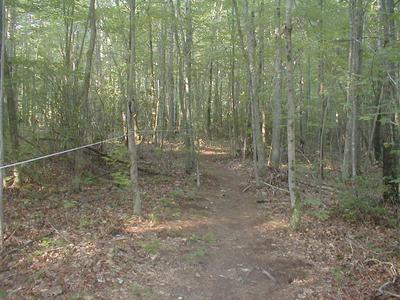
I had to look down to watch for poison ivy as I didn't have on any socks.

We got to the site and registered and started browsing the book booth. I wanted to buy everything in sight while Fay eyed the books about gardens, flowers and produce. I bought five back issues of Communities Magazine.

We milled around for a bit and finally it was time for dinner.
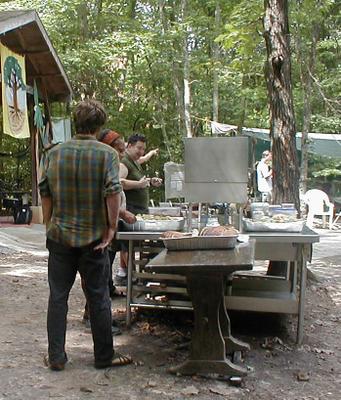
We ate at the least muddy table which turned out to be somewhat removed from everybody else (the picnic tables were arranged in a big circle around the fire pit) but eventually were were joined by Glen and Keith from Jubilee House, a Christian service community that helps war refugees.

After dinner we went to the pavilion for entertainment. We heard an electric piano player, Melody, who said who was a jazzpeace ambassador. Then we heard announcements. Then came the highlight of the evening. A couple (I didn't note their names, unfortunately) led us in a song.
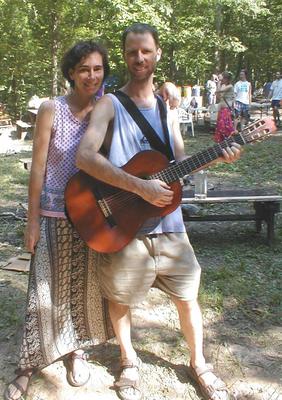
They said was the most frequently sung in America, according to their research. They had us stomping and clapping and lo and behold it turned out to be Queen's "We will, we will rock you!" The leader explained that the lyrics had come to mean "we will kick your ass" so we changed them to "We will build a New World!" It was great fun.

Then it was story telling time and several people stood up and told us stories from their communities. We heard what it was like for the East Wind Community to be covered by National Geographic (yikes!). The funniest part was when he explained that the women "dropped trou" (got nekked) whenever the photographer was around (despite it being October) because the wanted to see whether they would publish a white woman being bare chested. (They did--but doctored the picture to make it look sunny.)

We hiked the trail back to the van and got ready for bed. We were delighted to discover that there were hardly any bugs which was fortunate because it was so hot and we needed to leave the windows and doors open to have at least the appearance of air circulating.

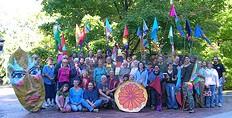
The next morning we got to breakfast before it was over and waited forever for the coffee to percolate. Then it was time for the Opening Circle. If you look really closely under the tree banner you can see someone leading the group in a rousing (considering the hour) rendition of "We come from the mountain."
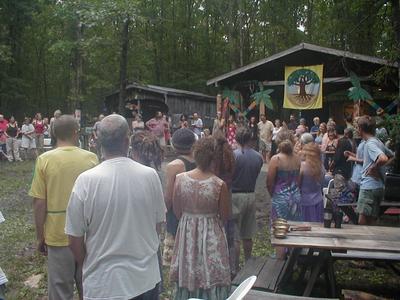
We met the organizers, Valerie and Sky who were really wonderful and did a great job.
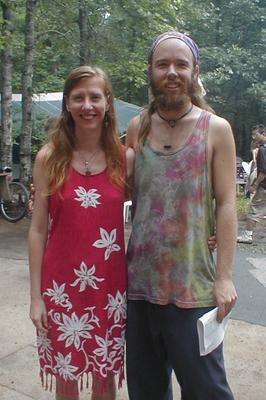
We had announcements and then it was time to "meet the communities." People in communities looking for new members took a minute each to tell a little bit about their group. After that they sat at the picnic tables and we stopped by the ones were were interested in to learn a little bit more. We took pictures of each one to help us remember them.

Eric told us about a community he was starting in northeast Tennessee on 60 acres. He is up there beginning to put in the infrastructure. Its very rustic living when you are first starting out.
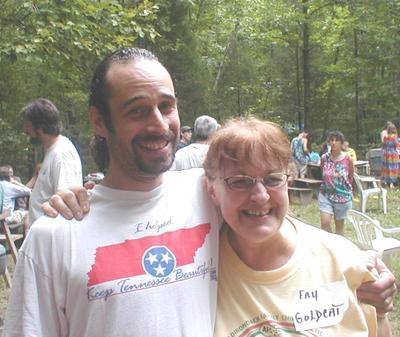
Neo-coho is no longer a cohousing group. Now they want to build and eco hamlet in NE Ohio. They don't have their land yet, but have the area and vision in mind.
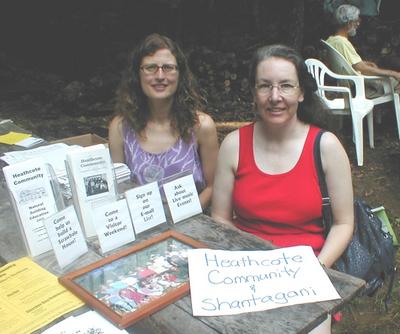
Heathcoate offers natural building courses which Mr. Logan is interested in, so I took a brochure.

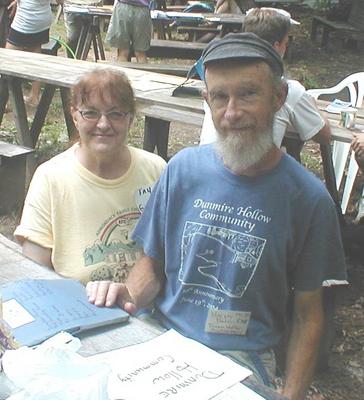
Dunmire Hollow is a small community 2 hours SW of Nashville. Harvey has a woodshop there.

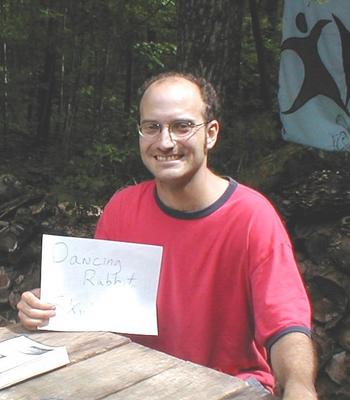
And I had to stop by Dancing Rabbit Ecovillage to see what they thought of their episode of 30 days with Morgan Spurlock (previously blogged here). Our host said that they were pleased overall--it didn't make them look too crazy and it had a lot of information about sustainable living. Compared to other media coverage of intentional communities they felt like they came out on top.
After lunch we had workshops, which I briefly covered in my earlier post on the conference. I went to one on cohousing--it was great, but I left halfway through to take a blessedly cold shower (did I mention it was hot? Later we found out it was about 99 degrees with a heat factor of 110). Then I went to one on visiting communities, a project that is on hold until we find out how severe the gasoline shortage is.

Fay went to a workshop on sustainable agriculture, and learned that shw could control her arch nemesis, kudzu, with grazing animals. (She noticed that the groundhogs liked it. Now on to the goats.)

Before you new it it was time to eat again. We got in the front of the line because we had KP duty after dinner. Everyone washed their own dishes in a series of buckets that were filled up and maintained by the crew:
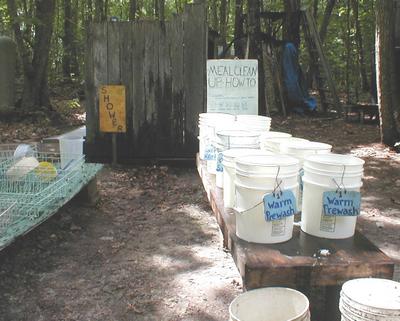
  • warm pre-wash
  • hot soapy wash
  • disinfect w/ clorox
  • cool rinse
  • put in the rack.

Then we took the dry dishes and stacked them back in the beginning of the food line.
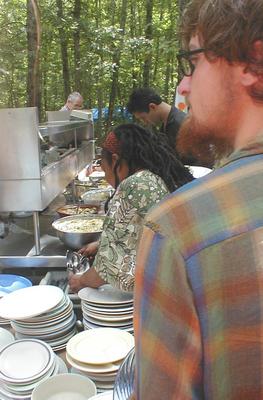
It was tiring work and we were very glad when our shift was over, especially because everybody had gone to a dessert party over at the community building at Twin Oaks. But to get there we had to walk half a mile down a dark path with Lions and Tigers and Bears (and frogs). After two false starts, one leading to the kids' area and one to an outhouse (the lights on the path fooled us), we finally got on the right one, and with one shared flashlight between us we made our way.

We came int though an industrial sized kitchen
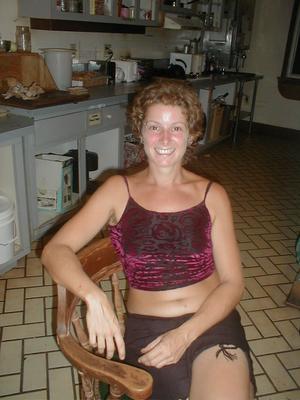
to the buffet where there was a huge spread of cakes and cookies and brownies. The cake was perfection (it was a leftover from a wedding that day) with a lot of delicious frosting. We were not moderate.

We read all of the signs, bulletins, and clipboards to get a tiny peek at the life at an income-sharing community. It was organized chaos. I guess your Mom really doesn't live here. But they had a nice selection of publications in their library. That is one great benefit of community living, shared cost of magazine subscriptions.

Then a Klezmer band started up in the hall
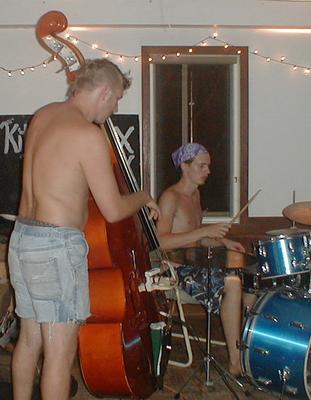
and soon the room filled with dancing people.
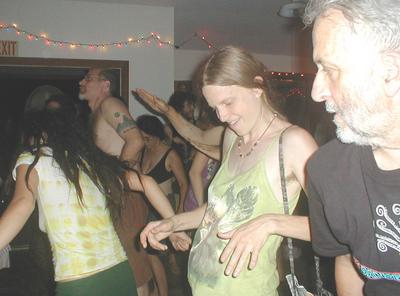
We were to tired to do much hopping around and as soon as we found out there was a shuttle going back to the campground we were on it. We even got a ride to our van.
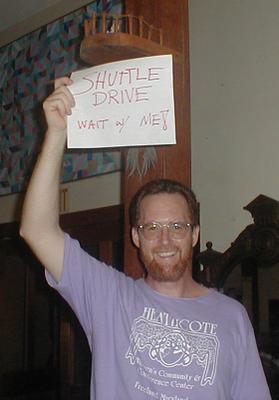
I slept in the next morning but made it in time to get the last pancake. Fay and I sat and talked and missed a group process called Open Spaces that I have since researched and can't wait to participate in. Nevertheless we tood advantage of the work they did setting and agenda and organizing sessions and went to workshops on building the local economy and culture, and natural building.

After lunch it was time for previously scheduled workshops again. I was torn between one called "Creating a healing culture in community" and "Conflict: fight, flight or opportunity?" I opted for the conflict one, in part because I had taught a course in conflict last year and was curious how this would compare to it. It was very good.

Then it was time for the closing circle. We had acknowledgements again, a few announcements, and then we were asked to close our eyes and review the weekend and come up with a word to sum it up. Then we went around the great circle and shared them. My word was "hope" and Fay's were "coming out of my shell." Other funny words included: "air conditioning is wonderful," "sweat," and "hmmm..."

We danced our good-byes.
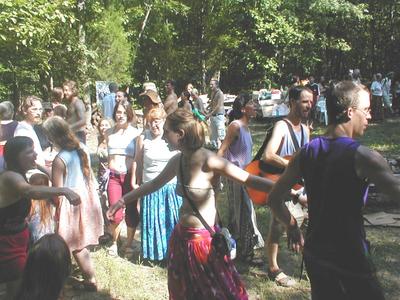
I was sad to go. I really enjoyed the special feeling of being with other people with the same values and dreams for saving (or at least surviving) the world through cooperative living. If you get a chance to go to a retreat with like minded people I highly recommend it. We need that support and revitalization.

Saturday, September 03, 2005

Today's links

To be honest I am just too disheartened to write much today. I am just going to post some links that resonated with me.

From the Boston Globe (via Energy Bulletin), a post by the editors of Grist Mill. (I know, its about time I had something of theirs on here.) . "...[I]t's time for us ordinary citizens to get active, too. Time to call our legislators, show up at city council meetings, write letters to the editor. After all, everyday Americans outnumber energy company executives by a ratio of roughly a bazillion to one -- so let's make sure the dialogue reflects that, and that our needs get proportionate attention."

From From the Wilderness: "Bottom line: my assessment is that New Orleans is never going to be rebuilt and that US domestic oil production will never again reach pre-Katrina levels."

From Planetizen (via worldchanging): "A strategy for retrofitting sprawl across the board regardless of existing densities and without absolute reliance on new construction and public transit must be found. I've called this the smart sprawl strategy..."

From deconsumption: Remembering Oil Shockwave, "an ultra-high level brainstorming conference which met a couple months ago to discuss the question of just what exactly might happen if a substantial disruption occurred to the American oil infrastructure."

From Slate (via Flying Talking Donkey): "A former deputy chief of FEMA told Knight Ridder Newspapers yesterday (Sept. 1) that there 'are two kinds of levees—the ones that breached and the ones that will be breached.' A similar aphorism applies to broadcasters: They come in two varieties, the ones that have gone stark, raving mad on air and the ones who will."

From how to save the world (also via Flying Talking Donkey) "Feeling anxious and short-tempered these days? I've noticed it everywhere since the news of Katrina's destruction and aftermath has sunk into public consciousness."

Friday, September 02, 2005

Today's snapshot

Like many of you I am sure, I have been listening to the news out of New Orleans all day. Its hard to take it all in. And I can't help wondering whether "community building skills" would help the morale. Probably just plain help would make the most difference. What would I do in those circumstances? I'd probably curl up in a ball and cry. But it brings to light the need for "social capital." When the stuff hits the fan (TSHTF in some circles) we are going to be dependent on each other to get through. Our government can't be counted on for many reasons. We need to become more self sufficient.

I have been trying to get an accurate picture of what is happening with the Colonial and Plantation pipelines. Here's a compilation of what I have found:

On August 31 CNN said:
One of two pipeline companies supplying gasoline to the eastern seaboard of the United States said Wednesday it hopes to be back in partial operation soon. The other pipeline is still waiting for an indication on when electricity to pumps will be restored.
On September 2nd The Washington Post reported:

Two major pipelines disrupted by Hurricane Katrina that provide much of the Washington area's gasoline showed signs of life yesterday, although it could be days before they are running up to full capacity. Colonial Pipeline Co. said that it was operating at 40 percent of capacity and that it hoped to operate at 61 percent by today and 86 percent by the middle of next week. Officials with the other pipeline, Plantation Pipe Line Co., said the line is operating at 25 percent.
On September 2nd The Atlanta Journal-Constitution weighed in:

Exacerbated by Wednesday's buying spree, the metro area came within four days of
running out of gasoline supplies, said U.S. Department of Transportation spokesman Brian Turmail. Hurricane Katrina had knocked out power to the two Gulf Coast pipelines that supply the Atlanta region's 7 million-gallon-a-day gasoline habit.

Power was partially restored Wednesday night and, by Thursday night, Alpharetta-based Colonial Pipeline Co. was nearing half capacity. The second, smaller pipeline was operating at 25 percent capacity.

availability of gas appears to be on the increase Friday in the metro Atlanta area, according to Tom Smith, director of the Georgia Association of Petroleum Retailers.

He estimates that one in every seven sellers in the metro region is completely without gasoline at their pumps. And perhaps one in five have run out of just a grade or two of fuel, he said.
On September 3rd The Atlanta Journal-Constitution actually quoted Matt Simmons! Is Peak Oil next?

Alpharetta-based Colonial Pipeline Co. was moving gasoline, diesel and jet fuel at two-thirds of its normal rate, while the smaller Plantation Pipe Line Co. was up to 95 percent.

Matt Simmons, a Houston-based investment banker in energy, worries that the good news is superficial, and will drive Americans back into complacency as energy resources dwindle.

After more than two years of research for his recent book, "Twilight in the Desert: Pending Oil Shock," Simmons concludes that the world's oil production has reached its highest point.

His tri-fold message is: open restricted oil fields, including the Alaskan wildlife refuge; [not worth it!] conserve existing supplies; and look for energy alternatives, including nuclear, [ack!] wind and solar. He said he hopes Americans don't sleep through Katrina's wake-up call.

"We're going to have to get used to paying realistic prices for our energy," Simmons said. "I think the quicker people start to realize that we've ended a very long era of inexpensive energy, the better off we'll be."

Today I had to run an unexpected errand not far from home, so I added on a trip to the library to it. Everything seemed normal--no lines or closed stations on the way. Mr. Logan said I was overeacting by not going to the gym today. Next week is when our reserves would run out if not replenished. That is when we will see the crunch, if it is to occur.

Thursday, September 01, 2005

More questions than answers

I've spent the morning looking for information about the pipelines serving Atlanta but had no luck. I did find the comments section of the Atlanta Journal-Constitution. The vast majority of the posts criticised the people who were frightened into panic buying last night as "sheeple" who weren't thinking for themselves, and criticised the gas stations--especially those at $6 a gallon--for price gouging. The main argument is that panic buying and stockpiling is causal to the gas shortage. It becomes a self-fulfilling prophesy.

But without good information it is difficult to know what to do. Friends of mine have stockpiled 35 gallons in their basement. Will I regret not doing the same? My husband wants to fill up our 5 gallon containers. I'm a bit nervous about storing gasoline. The propane is bad enough. (But I have to admit I love the grill.)

If we really do only have a 7 to 10 day supply and minimal resupply from our pipelines then things are going to deteriorate. What can I do to prepare for this eventuality? I guess it is time to stock up my pantry. Its been on my to do list but this may be it.

The Oil Drum is covering this story and has had extensive coverage on Katrina in general.

On the Silver Lining side, public transit ridership in Atlanta is in record numbers.

I'll update our situation here as I get more information.

Update:
The Columbus Ledger-Enquirer writes:

As for Colonial Pipeline, it is working to install generator equipment at its facilities in Louisiana and Mississippi. The company said the power from these generators will allow them to gradually increase the system's capacity through the weekend, hopefully to as much as 50 percent to 60 percent. Colonial Pipeline is owned by five oil companies -- Koch Capital Investments, HUTTS, Citgo, Phillips and Shell.
This confirms what I heard on CNN so hopefully help is coming.